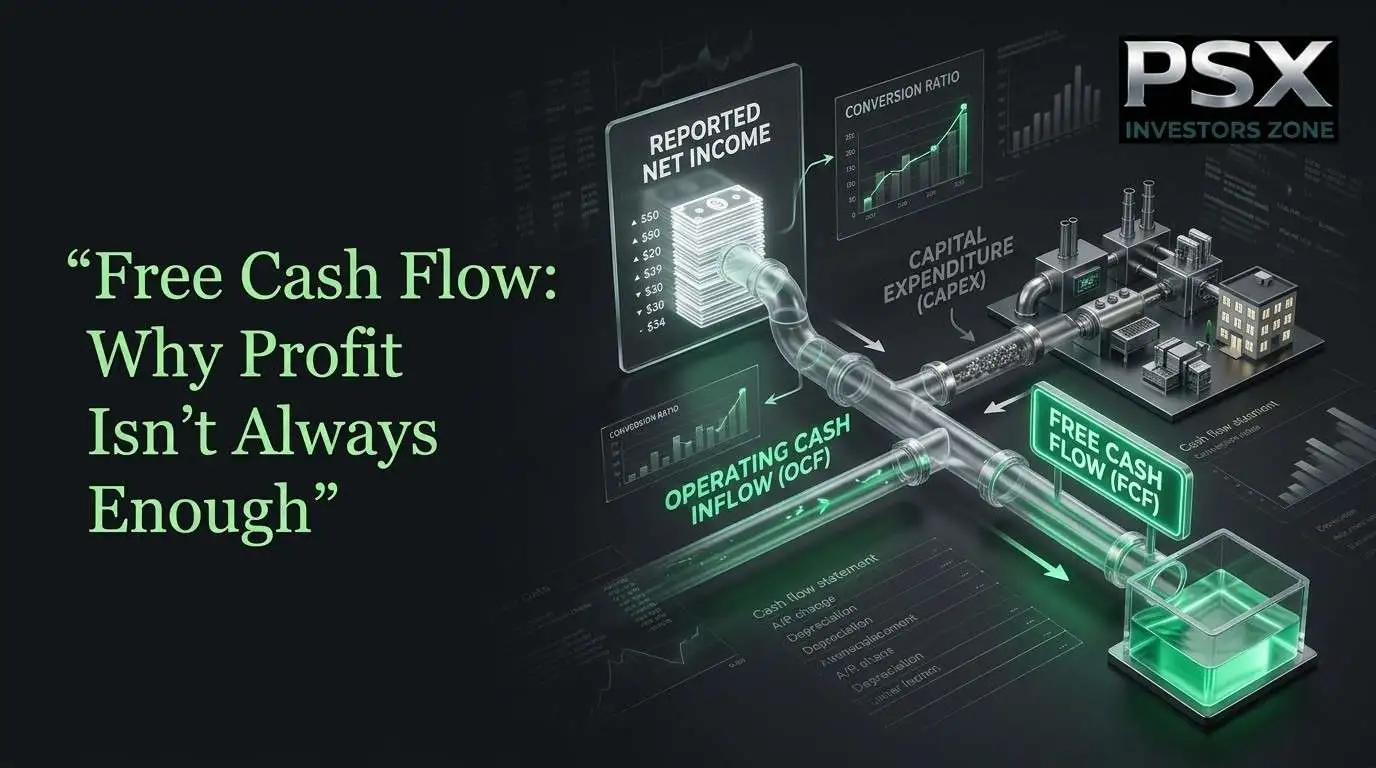
Free Cash Flow: Why Profit Isn't Always Enough
Introduction
When investors analyze a company, one of the first numbers they usually look at is profit.
Profit is important—but it does not tell the complete story.
A company can report strong net income while generating relatively weak cash flow. This can happen because accounting profit includes items that do not immediately represent cash movement, while businesses also need to spend cash on equipment, property, technology, inventory and other assets.
This is where Free Cash Flow (FCF) becomes useful.
Free Cash Flow helps investors understand how much cash a business generates after accounting for the capital expenditure required to maintain or grow its operations.
For PSX investors, FCF can provide valuable insight into:
- Dividend sustainability
- Debt repayment capacity
- Business quality
- Financial flexibility
- Reinvestment potential
- Long-term value creation
The key lesson is simple:
Profit tells you whether a company is profitable. Free Cash Flow helps show how much cash the business is actually generating after necessary capital investment.
Important: This article is for educational purposes only and does not recommend any specific PSX stock or guarantee investment returns.
What Is Free Cash Flow?
Free Cash Flow is the cash a company generates from its operations after spending on capital expenditures.
A commonly used simplified formula is:
Free Cash Flow = Operating Cash Flow − Capital Expenditure
Example
Suppose a company reports:
- Operating Cash Flow = Rs. 10 billion
- Capital Expenditure = Rs. 4 billion
Then:
FCF = Rs. 10 billion − Rs. 4 billion
FCF = Rs. 6 billion
The company generated approximately Rs. 6 billion in free cash flow after capital expenditure.
This cash can potentially be used for:
- Dividends
- Debt repayment
- Business expansion
- Share buybacks where applicable
- Acquisitions
- Building cash reserves
Why Isn't Profit Always Enough?
Imagine Company A reports:
Net Profit = Rs. 10 billion
That sounds strong.
But suppose its operating cash flow is only:
Rs. 4 billion
And the company spends:
Rs. 7 billion on capital expenditure
Its simplified FCF would be:
Rs. 4 billion − Rs. 7 billion = −Rs. 3 billion
The company is profitable on an accounting basis but has negative free cash flow.
This does not automatically mean the company is financially weak.
It may be investing heavily in:
- A new factory
- Production capacity
- Technology
- Infrastructure
- Expansion projects
However, investors should understand why FCF is negative and whether the spending is likely to generate future returns.
Profit vs Cash Flow
Profit and cash flow measure different things.
| Metric | What It Tells You |
|---|---|
| Revenue | Sales generated |
| Net Profit | Accounting earnings after expenses |
| Operating Cash Flow | Cash generated from core operations |
| Capital Expenditure | Cash spent on long-term assets |
| Free Cash Flow | Cash remaining after capital expenditure |
A good investor should understand all of these rather than relying on a single number.
How Is Free Cash Flow Calculated?
The basic calculation is:
FCF = Operating Cash Flow − Capital Expenditure
Step 1: Find Operating Cash Flow
Operating cash flow is found in the company's cash flow statement.
It measures cash generated or consumed through operating activities.
Step 2: Find Capital Expenditure
Capital expenditure, commonly called CapEx, represents spending on long-term assets.
Examples include:
- Property
- Plants
- Machinery
- Equipment
- Technology infrastructure
Step 3: Subtract CapEx
The remaining amount provides a simplified measure of free cash flow.
Where Can PSX Investors Find FCF Information?
Investors should normally begin with a company's:
- Annual report
- Quarterly financial statements
- Cash flow statement
- Notes to financial statements
Operating cash flow is generally reported directly in the statement of cash flows.
Capital expenditure may require closer examination because it can appear under different descriptions depending on the company's financial reporting.
Look for items such as:
- Purchases of property, plant and equipment
- Purchases of fixed assets
- Additions to property and equipment
- Capital expenditures
Always read the relevant notes when the figure is unclear.
Why Free Cash Flow Matters for Dividend Investors
Dividends are ultimately paid with cash.
A company can report profits but still face cash constraints.
Suppose:
Net Profit = Rs. 8 billion
but:
Free Cash Flow = Rs. 2 billion
If the company wants to distribute Rs. 7 billion in dividends, investors should ask:
Where will the additional cash come from?
The company may have:
- Existing cash reserves
- Debt financing
- Asset sales
- Other sources of liquidity
But persistent differences between accounting profits and available cash deserve investigation.
This is why FCF can be particularly useful when evaluating dividend sustainability.
Free Cash Flow and Debt
Strong free cash flow can provide a company with greater flexibility to reduce debt.
For example:
FCF = Rs. 5 billion
A company could potentially use some of that cash to:
- Repay loans
- Reduce interest costs
- Strengthen its balance sheet
Conversely, a highly indebted company with persistently weak FCF may face greater financial pressure.
Investors should therefore analyze:
FCF + Debt + Interest Obligations
together.
Free Cash Flow and Business Quality
A business that consistently converts earnings into cash can be attractive from a fundamental-analysis perspective.
Consider two companies:
Company A
- Growing earnings
- Positive operating cash flow
- Consistent FCF
- Manageable debt
Company B
- Growing reported earnings
- Weak operating cash flow
- Persistent negative FCF
- Rising debt
Both may report profit growth, but their financial characteristics are very different.
This does not automatically make Company A the better investment.
Valuation and future growth still matter.
But FCF provides an additional layer of analysis.
What Is Negative Free Cash Flow?
Negative FCF means:
Capital Expenditure > Operating Cash Flow
This can happen for several reasons.
Positive Reason
The company is investing aggressively in future growth.
Potentially Concerning Reason
The company's core business is not generating enough cash to support its operations and investment requirements.
Therefore:
Negative FCF is a signal to investigate—not an automatic sell signal.
When Negative FCF Can Be Acceptable
Some companies naturally require substantial investment.
For example:
- Energy companies
- Infrastructure businesses
- Manufacturing companies
- Telecommunications companies
- Expanding industrial businesses
A company may temporarily experience negative FCF while building new capacity.
The key questions are:
Why is FCF negative?
How long has it been negative?
What return is expected from the investment?
Can the company finance the expansion safely?
When Negative FCF Becomes a Warning Sign
Persistent negative FCF can become more concerning when:
- Revenue growth is weak
- Earnings are declining
- Debt is increasing
- Interest costs are rising
- Operating cash flow is deteriorating
- Capital expenditure produces weak returns
In that situation, investors should investigate whether the company's business model is generating enough cash.
Free Cash Flow Margin
Investors can also compare FCF with revenue.
Formula
FCF Margin = Free Cash Flow ÷ Revenue × 100
For example:
Revenue = Rs. 100 billion
FCF = Rs. 15 billion
FCF Margin:
15 ÷ 100 × 100 = 15%
A higher FCF margin generally indicates that a larger portion of revenue is being converted into free cash flow.
However, FCF margins vary significantly across industries.
Therefore, compare companies with similar business models.
Free Cash Flow Per Share
Investors can also calculate FCF on a per-share basis.
Formula
FCF Per Share = Free Cash Flow ÷ Number of Shares Outstanding
For example:
FCF = Rs. 5 billion
Shares outstanding = 1 billion
FCF per share = Rs. 5
This can help investors compare cash generation with the stock's market price.
Price-to-Free-Cash-Flow Ratio
Another valuation metric is the Price-to-Free-Cash-Flow (P/FCF) ratio.
A simplified calculation is:
P/FCF = Market Capitalization ÷ Free Cash Flow
Or on a per-share basis:
P/FCF = Share Price ÷ FCF Per Share
A lower P/FCF can sometimes indicate a cheaper valuation relative to cash generation.
But investors should not automatically assume that a lower ratio is better.
The company may have:
- Declining FCF
- Temporary cash generation
- High capital requirements
- Weak future prospects
Always combine valuation with business fundamentals.
Free Cash Flow vs Earnings Per Share
EPS is an important metric, but it measures accounting earnings per share.
FCF focuses on cash generation after capital expenditure.
Consider:
EPS rising + FCF rising
This can be a particularly useful combination.
But:
EPS rising + FCF declining
deserves closer examination.
It does not automatically indicate accounting manipulation or poor business quality.
There may be legitimate reasons for the difference.
The investor's job is to understand the reason.
Free Cash Flow and Working Capital
Working capital can have a major effect on operating cash flow.
Changes in:
- Receivables
- Inventory
- Payables
can cause operating cash flow to differ significantly from net profit.
For example, a company may record sales as revenue but not yet collect the cash from customers.
Profit increases.
But cash has not necessarily arrived.
This is why investors should examine the relationship between:
Profit → Receivables → Operating Cash Flow
Watch Accounts Receivable
Rapid growth in receivables can sometimes explain why profit is increasing faster than cash flow.
For example:
Revenue increases by 20%.
Profit increases by 25%.
But receivables increase by 50%.
This may deserve investigation.
Possible explanations include:
- Longer customer payment periods
- Strong business growth
- Changes in credit terms
- Collection delays
- Customer concentration
Do not automatically assume something is wrong.
Instead, investigate the underlying business reason.
Free Cash Flow and Capital Expenditure
CapEx deserves special attention.
Not all capital expenditure has the same purpose.
Maintenance CapEx
Spending required to maintain existing operations.
Growth CapEx
Spending intended to expand future production or revenue.
A company with high growth CapEx may temporarily generate lower FCF.
Investors should determine whether the investment is expected to produce attractive future returns.
Free Cash Flow Conversion
Another useful concept is cash conversion.
A simplified comparison is:
FCF Conversion = FCF ÷ Net Profit × 100
For example:
Net Profit = Rs. 10 billion
FCF = Rs. 7 billion
FCF Conversion = 70%
This means the company generated FCF equivalent to 70% of reported net profit.
The ratio can fluctuate from year to year.
It becomes more useful when examined over several years.
Look at FCF Over Multiple Years
One year is rarely enough.
Build a 5-year history if possible.
For each year, record:
| Year | Net Profit | Operating Cash Flow | CapEx | FCF |
|---|---|---|---|---|
| Year 1 | — | — | — | — |
| Year 2 | — | — | — | — |
| Year 3 | — | — | — | — |
| Year 4 | — | — | — | — |
| Year 5 | — | — | — | — |
Look for patterns.
Positive Pattern
Profit ↑
Operating Cash Flow ↑
FCF ↑
Potential Warning
Profit ↑
Operating Cash Flow ↓
FCF ↓
The second pattern deserves further investigation.
Free Cash Flow for Different PSX Sectors
FCF should be interpreted according to the industry.
Banks
Traditional FCF calculations are generally less useful for banks because their business model and cash-flow structure differ from non-financial companies.
For banks, investors should focus more on:
- Earnings
- Capital adequacy
- Loan quality
- Deposits
- Liquidity
- Net interest margin
Cement
Monitor:
- Operating cash flow
- CapEx
- Capacity expansion
- Energy costs
- Debt
Oil & Gas
Monitor:
- Operating cash flow
- Production
- Commodity prices
- Exploration spending
- Development CapEx
Technology
Monitor:
- Operating cash flow
- Revenue growth
- Capital requirements
- International cash generation
Consumer Companies
Monitor:
- Operating cash flow
- Receivables
- Inventory
- CapEx
- Margins
The correct analysis depends on the business model.
7 Questions to Ask About a Company's FCF
Before investing, ask:
1. Is FCF positive?
If not, understand why.
2. Is FCF growing?
Look at several years.
3. Does FCF support reported earnings?
Compare cash flow with net profit.
4. Is CapEx unusually high?
Understand whether it is maintenance or growth spending.
5. Can FCF support dividends?
Check dividend payments against cash generation.
6. Can FCF reduce debt?
Compare cash generation with debt obligations.
7. Is the stock reasonably valued?
Strong FCF does not make an expensive stock automatically attractive.
Common Mistakes When Analyzing FCF
Mistake 1: Assuming Positive FCF Means a Good Investment
A company can generate strong cash flow but still be overpriced.
Mistake 2: Treating Negative FCF as Automatically Bad
Expansion can temporarily reduce FCF.
Mistake 3: Looking at Only One Year
Cash flows can fluctuate significantly.
Mistake 4: Ignoring Capital Expenditure
Operating cash flow alone does not show the cash remaining after investment in long-term assets.
Mistake 5: Comparing Different Industries
FCF characteristics differ substantially across business models.
Mistake 6: Ignoring Working Capital
Receivables, inventory and payables can materially affect cash generation.
A Practical PSX FCF Checklist
Before investing in a PSX company, review:
- Net profit
- EPS
- Operating cash flow
- Capital expenditure
- Free cash flow
- FCF margin
- FCF per share
- FCF trend
- Receivables
- Inventory
- Debt
- Interest expense
- Dividend payments
- P/FCF where appropriate
- Future capital requirements
Then compare the results with companies in the same sector.
Free Cash Flow and Shariah-Compliant Investing
For investors following Shariah-compliant principles, FCF is useful for understanding financial strength, but it does not determine Shariah compliance by itself.
Investors should separately verify:
- The company's core business activity
- Shariah screening status
- Relevant financial ratios
- Applicable screening methodology
- Latest available compliance information
A company with strong FCF is not automatically Shariah-compliant.
Likewise, a Shariah-compliant company should still be evaluated for valuation and financial quality.
Key Takeaways
- Profit and cash flow are not the same thing.
- Free Cash Flow is commonly calculated as operating cash flow minus capital expenditure.
- Positive FCF can provide financial flexibility for dividends, debt repayment and reinvestment.
- Negative FCF is not automatically bad; investors should understand the reason.
- Compare FCF with net profit to identify differences between accounting earnings and cash generation.
- Watch receivables, inventory and working capital.
- Analyze CapEx carefully.
- Examine FCF over several years rather than relying on one period.
- Use FCF alongside EPS, ROE, debt, valuation and other financial metrics.
- FCF analysis should be adapted to the company's industry.
- Traditional FCF analysis is less suitable for financial institutions such as banks.
- Strong FCF does not automatically make a stock a good investment.
- Shariah compliance should be evaluated separately using current screening information.
Frequently Asked Questions
What is Free Cash Flow?
Free Cash Flow is the cash generated by a company after accounting for capital expenditure. A commonly used simplified formula is operating cash flow minus capital expenditure.
Why is Free Cash Flow important?
FCF helps investors understand how much cash a business generates after investing in long-term assets. It can help assess financial flexibility, dividend capacity and debt repayment ability.
Can a profitable company have negative Free Cash Flow?
Yes. A company can report accounting profits while generating negative FCF, particularly when it is making significant investments in capital expenditure.
Is positive Free Cash Flow always a good sign?
Not necessarily. Investors should examine the sustainability of FCF, the company's valuation, business growth prospects, debt and future capital requirements.
What is the difference between profit and Free Cash Flow?
Profit is an accounting measure of earnings, while FCF focuses on cash generated after capital expenditure. The two can differ because of non-cash accounting items and working-capital changes.
How can I find FCF for a PSX company?
Start with the company's annual or quarterly financial statements. Review the statement of cash flows for operating cash flow and examine the relevant financial-statement notes for capital expenditure.
Should I use FCF to analyze banks?
Traditional FCF calculations are generally less meaningful for banks because financial institutions have fundamentally different cash-flow structures. Bank-specific metrics such as capital adequacy, loan quality, deposits and net interest margins are generally more appropriate.
What is a good FCF margin?
There is no universal "good" FCF margin. It varies significantly by industry and business model. Compare a company's FCF margin with its historical performance and relevant sector peers.
Does strong FCF mean a stock is undervalued?
No. Strong FCF can indicate healthy cash generation, but investors must still evaluate the company's market price and valuation.
Conclusion
Free Cash Flow provides an important perspective that profit alone cannot provide.
A company can report impressive earnings while using substantial amounts of cash to fund receivables, inventory, capital expenditure or other investments.
That is why PSX investors should look beyond the income statement.
A useful analytical sequence is:
Net Profit → Operating Cash Flow → Capital Expenditure → Free Cash Flow → Debt & Dividends → Valuation
The objective is not simply to find companies with the highest FCF.
Instead, look for businesses that can consistently generate healthy cash flow, deploy that cash productively, maintain a sound balance sheet and trade at a reasonable valuation.
For long-term investors, understanding Free Cash Flow can help reveal the difference between accounting profitability and actual cash-generating power.
Educational Disclaimer: This article is for educational purposes only and does not constitute financial, investment, legal, tax, or Shariah advice. Financial results and cash flows can change, and no metric guarantees investment performance. Investing in the Pakistan Stock Exchange involves risk, including possible loss of capital. Always conduct your own research and verify the latest company financial statements and Shariah screening information before making investment decisions.