History of the Pakistan Stock Exchange (PSX): From KSE to PSX
Introduction
The Pakistan Stock Exchange (PSX) is today the country's primary stock exchange, providing a regulated marketplace where investors can buy and sell shares and other listed securities.
But PSX did not appear overnight.
Its history goes back several decades and reflects the development of Pakistan's capital markets, from a small trading environment in Karachi to a modern, technology-driven national stock exchange.
Understanding the history of PSX can help investors appreciate how Pakistan's stock market developed and why today's exchange operates as a unified national platform.
The story can broadly be described as:
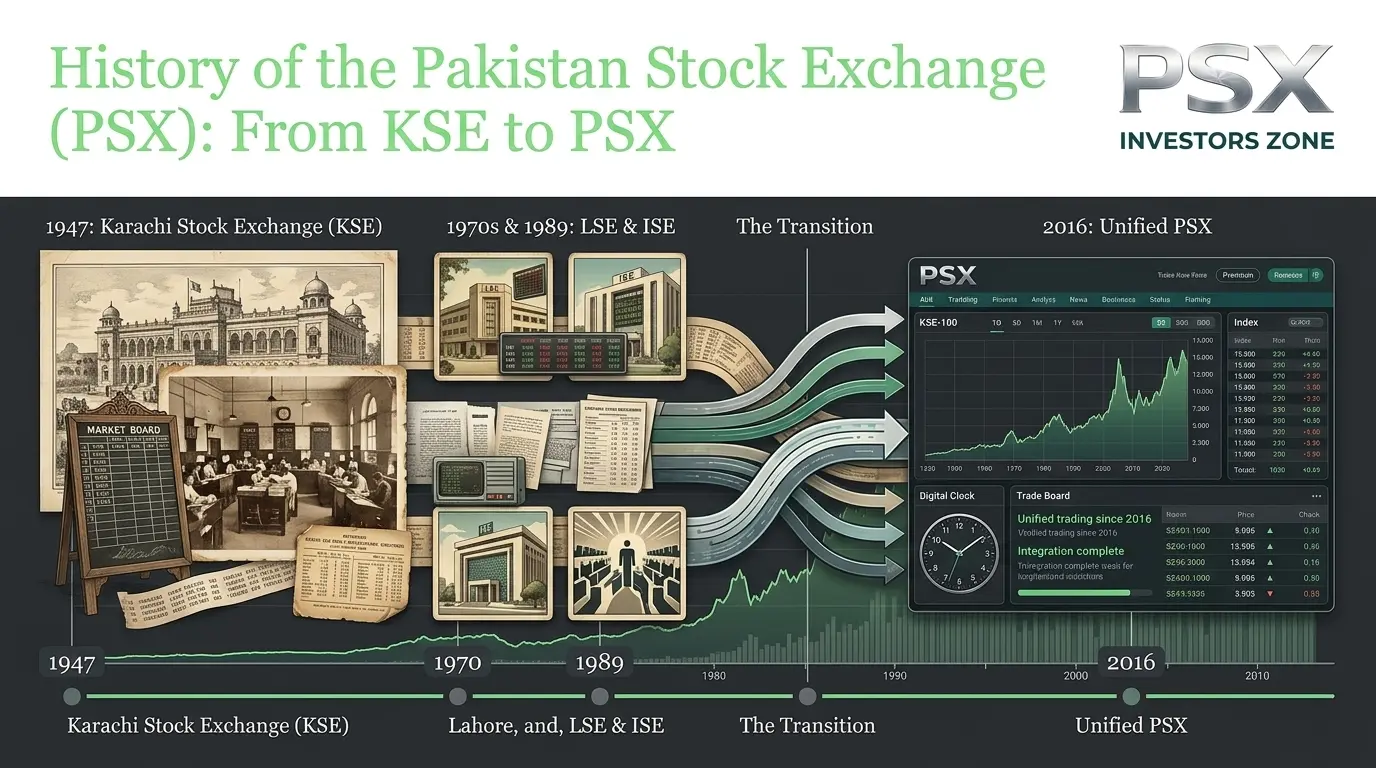
Karachi Stock Exchange → Three Regional Exchanges → Demutualization & Integration → Pakistan Stock Exchange
Let's explore the major milestones.
When Was the Stock Market Established in Pakistan?
Pakistan's organized stock-market history began shortly after independence.
The Karachi Stock Exchange (KSE) was established in 1947, making it the country's first stock exchange.
It began operations in Karachi with a small number of listed companies and gradually developed as Pakistan's principal securities market.
Over the following decades, the exchange expanded alongside Pakistan's economy and corporate sector.
As more companies sought access to capital and more investors entered the market, the country's securities-market infrastructure continued to develop.
The Early Years of Karachi Stock Exchange
In its early years, the Karachi Stock Exchange was considerably smaller than today's PSX.
Trading activity was limited compared with the modern market, and the systems used to execute and record transactions were far less sophisticated than today's electronic platforms.
As Pakistan's corporate sector expanded, the number of listed companies and investors increased.
The exchange gradually became an important mechanism for:
- Raising corporate capital
- Buying and selling shares
- Price discovery
- Providing investment opportunities
- Connecting investors with listed companies
This foundation eventually contributed to the development of Pakistan's broader capital-market infrastructure.
Lahore Stock Exchange and Islamabad Stock Exchange
Karachi was not the only center of organized securities trading in Pakistan.
The Lahore Stock Exchange (LSE) was established in 1970, while the Islamabad Stock Exchange (ISE) was established in 1989.
Pakistan therefore had three separate stock exchanges:
- Karachi Stock Exchange
- Lahore Stock Exchange
- Islamabad Stock Exchange
Each exchange served investors and listed companies within Pakistan's capital-market system.
However, maintaining multiple exchanges also created an opportunity to improve efficiency by integrating the country's securities markets.
Why Did Pakistan Need a Unified Stock Exchange?
Having separate exchanges created fragmentation within the country's capital market.
A unified exchange could potentially provide:
- A single national marketplace
- Greater liquidity
- More efficient trading
- Better market integration
- Unified technology
- Improved investor access
- More consistent market infrastructure
This became an important objective in the modernization of Pakistan's capital markets.
The process eventually led to the creation of the Pakistan Stock Exchange.
What Was Demutualization?
One of the major steps in the development of Pakistan's stock exchanges was demutualization.
Traditionally, stock exchanges were structured around members who could also have ownership and trading rights.
Demutualization separates these functions by transforming the exchange into a corporate structure with clearer distinctions between:
- Ownership
- Management
- Trading rights
Pakistan's stock exchanges underwent this transformation as part of broader capital-market reforms.
The Stock Exchanges (Corporatization, Demutualization and Integration) Act, 2012 provided an important legal framework for the corporatization, demutualization and eventual integration of the country's stock exchanges.
This reform helped establish the foundation for a unified national exchange.
Creation of Pakistan Stock Exchange
The three exchanges were eventually integrated to form the Pakistan Stock Exchange Limited (PSX).
PSX officially commenced operations as a unified exchange on January 11, 2016.
This was one of the most important milestones in the history of Pakistan's capital market.
The integration brought together:
Karachi Stock Exchange + Lahore Stock Exchange + Islamabad Stock Exchange
under one national platform.
The creation of PSX provided investors with a unified marketplace rather than three separate regional exchanges.
What Happened to KSE?
The Karachi Stock Exchange did not simply disappear.
Instead, it became part of the integration process that created the Pakistan Stock Exchange.
This is why older Pakistani stock-market references frequently use the term KSE, particularly when discussing historical market data and the KSE-100 Index.
Today, the national exchange is known as Pakistan Stock Exchange (PSX).
The historical connection can therefore be summarized as:
KSE → Integration of Pakistan's Exchanges → PSX
What Is the KSE-100 Index?
The KSE-100 Index is one of the most recognized benchmarks of Pakistan's stock market.
Despite the transition from KSE to PSX, the KSE-100 name continued because of its historical importance and established identity.
The index is designed to represent major companies listed on the exchange and is widely followed as a benchmark for market performance.
Investors and financial media frequently use the KSE-100 to discuss whether Pakistan's stock market is rising, falling, entering a bull market or experiencing a correction.
Therefore, when you see terms such as:
KSE-100
and
PSX
they are not necessarily referring to two different modern exchanges.
KSE is historically associated with Karachi Stock Exchange, while PSX is the current national stock exchange.
From Manual Trading to Electronic Trading
The technology used by Pakistan's stock market has changed dramatically over time.
Early stock-market trading relied heavily on traditional floor-based processes.
As technology developed, Pakistan's exchanges moved toward automated trading systems.
Electronic trading improved the ability to:
- Execute orders
- Match buyers and sellers
- Display market prices
- Process transactions
- Improve transparency
- Handle increasing trading volumes
The modern PSX operates through electronic systems, allowing investors and brokers to participate in a much more technologically advanced marketplace than existed during the early KSE era.
The Role of Technology in Modern PSX
Technology has transformed how investors interact with the stock market.
Today, investors can generally access market information through:
- Online trading platforms
- Mobile applications
- Broker platforms
- Market-data systems
- Financial websites
- Company announcements
- Digital research tools
This has significantly reduced the dependence on traditional physical trading environments.
For today's investor, understanding financial statements and market data is often more important than physically being present at an exchange.
International Participation in Pakistan's Stock Market
Pakistan's capital market has also attracted interest from international investors over the years.
Foreign investors can provide additional liquidity and international capital to the market.
Their participation can also influence market sentiment and individual sectors.
However, foreign investment flows can change because of:
- Global interest rates
- Currency conditions
- Economic expectations
- Political developments
- Emerging-market sentiment
- Pakistan's macroeconomic conditions
Therefore, foreign investment is an important part of understanding the broader evolution of PSX.
PSX and Pakistan's Economic Development
A stock exchange plays an important role in a country's capital-market system.
Companies can use equity markets to raise capital for:
- Expansion
- New projects
- Acquisitions
- Technology
- Production capacity
- Working capital
Investors, meanwhile, can participate in the economic performance of listed companies.
This creates an important connection:
Companies need capital → Investors provide capital → Businesses grow → Capital markets develop
A functioning stock exchange therefore contributes to the broader financial infrastructure of an economy.
Growth of the Listed Company Base
As Pakistan's corporate sector expanded, more companies became publicly listed.
Listed companies have historically represented a wide range of industries, including:
- Banking
- Fertilizer
- Cement
- Oil and gas
- Power
- Pharmaceuticals
- Technology
- Automobile
- Chemicals
- Textile
- Food
- Engineering
This sector diversity allows investors to research businesses with different economic characteristics.
It also means that developments affecting one sector do not necessarily affect every company in the same way.
Development of Islamic Investing in PSX
Another important development in Pakistan's capital market has been the growth of Shariah-compliant investing.
Pakistan has developed dedicated Islamic indices and investment products for investors seeking Shariah-compliant opportunities.
These include:
- PSX-KMI All Share Index
- KMI 30 Index
- Meezan Pakistan Index
- Shariah-compliant ETFs
- Sukuk and other Islamic capital-market products
The PSX-KMI All Share Index provides a benchmark for Shariah-compliant companies under the applicable screening methodology.
This development is particularly relevant for investors who want to participate in Pakistan's stock market while following Islamic investment principles.
KMI 30 and Shariah-Compliant Investing
The KMI 30 Index tracks 30 of the most liquid Shariah-compliant companies listed on PSX.
It provides investors with another way to follow the performance of major Shariah-compliant companies.
However, investors should remember:
Shariah compliance does not guarantee investment performance.
A compliant company can still experience:
- Falling profits
- Declining share prices
- Competitive pressure
- Economic challenges
- Valuation risk
Investors should therefore combine Shariah screening with proper financial and fundamental analysis.
Important PSX Historical Timeline
Here is a simplified timeline of major developments.
| Year | Major Development |
|---|---|
| 1947 | Karachi Stock Exchange established |
| 1970 | Lahore Stock Exchange established |
| 1989 | Islamabad Stock Exchange established |
| 2012 | Stock Exchanges (Corporatization, Demutualization and Integration) Act introduced |
| 2016 | Pakistan's three stock exchanges integrated into PSX |
| 2016 onward | PSX operates as Pakistan's unified national stock exchange |
This timeline provides a simple way to understand the transition from regional exchanges to the modern PSX.
Why Was PSX Created?
The creation of PSX was intended to create a more integrated and efficient capital market.
A national exchange could help provide:
Greater Market Integration
Investors could participate through one national marketplace.
Improved Liquidity
Combining trading activity could potentially improve market depth.
Better Infrastructure
A unified exchange could standardize technology and operational systems.
Greater Accessibility
Investors could access a broader market through the national platform.
Stronger Capital-Market Development
A unified exchange provides infrastructure for continued development of Pakistan's equity market.
PSX vs KSE: What Is the Difference?
This is a common question among beginners.
KSE
KSE stands for Karachi Stock Exchange.
It was Pakistan's oldest stock exchange and historically served as the country's main securities marketplace.
PSX
PSX stands for Pakistan Stock Exchange.
It is the unified national exchange created through the integration of Karachi, Lahore and Islamabad stock exchanges.
In Simple Terms
KSE = Historical Karachi exchange
PSX = Modern unified Pakistan Stock Exchange
This distinction is especially useful when reading older financial articles or historical market data.
What Does PSX Do Today?
Modern PSX provides the marketplace and infrastructure for trading listed securities.
Its functions include supporting:
- Equity trading
- New listings
- Market information
- Price discovery
- Capital raising
- Investor access
- Shariah-compliant market segments
PSX also publishes market information and index data that investors use to monitor the market.
The exchange operates within Pakistan's broader regulatory framework, with the Securities and Exchange Commission of Pakistan (SECP) playing a central regulatory role.
How PSX Has Changed for Investors
The experience of investing today is very different from the early years of KSE.
Then
Investors faced:
- Limited market information
- Traditional trading systems
- Fewer listed companies
- Less accessible financial data
Today
Investors can access:
- Online trading
- Real-time or near-real-time market information through available platforms
- Financial statements
- Company announcements
- Digital research
- Mobile trading applications
- Islamic market information
Technology has made access easier.
But easier access does not necessarily mean easier investing.
Investors still need knowledge, discipline and risk management.
The Evolution of PSX Market Indices
Indices have become an important part of understanding Pakistan's stock market.
Among the best-known indices are:
- KSE-100 Index
- KSE-30 Index
- PSX All Share Index
- KMI 30
- PSX-KMI All Share Index
These indices serve different purposes.
Some represent broad market performance, while others focus on specific groups of companies or Shariah-compliant securities.
Beginners should understand what an index represents before using it to judge the performance of an individual stock.
PSX and the Modern Investor
The modern PSX investor has access to far more information than investors did decades ago.
But information overload can create a different challenge.
Investors may encounter:
- Social-media stock tips
- Market rumors
- Breaking news
- Short-term predictions
- Technical signals
- Unverified investment claims
The availability of more information does not automatically produce better investment decisions.
A disciplined investor should distinguish between:
Information → Analysis → Decision
rather than:
Headline → Emotion → Trade
What Can Beginners Learn From PSX History?
The history of PSX provides several important lessons.
Markets Evolve
Trading systems, technology and regulations continue to change.
Infrastructure Matters
A well-developed exchange helps companies raise capital and investors participate in markets.
Index Names Can Have Historical Roots
The KSE-100 name continues to carry the history of Karachi Stock Exchange even though today's national exchange is PSX.
Regulation Matters
Capital markets require rules, oversight and transparent processes.
Technology Changes Access
Investors today have dramatically easier access to market information than earlier generations.
History Does Not Guarantee Future Returns
Past market performance does not guarantee future results.
What Is the Future of PSX?
The future development of Pakistan's stock market will depend on many factors.
These may include:
- Economic growth
- Corporate profitability
- Interest rates
- Inflation
- Foreign investment
- Domestic investor participation
- Regulatory reforms
- Digital technology
- New listings
- Capital-market development
Technology will likely continue changing how investors access information and execute trades.
At the same time, the fundamental principles of investing remain relevant:
Understand the business → Analyze the financials → Assess valuation → Manage risk → Stay disciplined
Why PSX History Matters to Investors
Learning history is not simply about memorizing dates.
It helps investors understand how the market they participate in came into existence.
When an investor understands that PSX developed from three regional exchanges into a unified national marketplace, terms such as KSE, KSE-100, PSX and KMI become much easier to understand.
It also puts today's technology, regulation and market structure into context.
Key Takeaways
- The history of Pakistan's organized stock market dates back to 1947.
- Karachi Stock Exchange was established in 1947.
- Lahore Stock Exchange was established in 1970.
- Islamabad Stock Exchange was established in 1989.
- Pakistan's three stock exchanges were eventually integrated.
- Pakistan Stock Exchange began operations as a unified exchange on January 11, 2016.
- KSE refers to the historical Karachi Stock Exchange.
- PSX is the modern unified national stock exchange.
- The KSE-100 remains one of Pakistan's best-known market benchmarks.
- Pakistan's capital market has transitioned from traditional trading toward electronic systems.
- PSX provides access to companies across many sectors of Pakistan's economy.
- Shariah-compliant investment options and Islamic indices have become an important part of the market.
- PSX operates within Pakistan's regulatory framework, with SECP playing a key regulatory role.
- A stock exchange helps facilitate capital raising, price discovery and investment.
- Understanding PSX history can help beginners understand today's market structure.
- Historical performance does not guarantee future investment returns.
Frequently Asked Questions
When was the Pakistan Stock Exchange established?
Pakistan Stock Exchange began operations as a unified national exchange on January 11, 2016, following the integration of Karachi, Lahore and Islamabad stock exchanges.
When was Karachi Stock Exchange established?
Karachi Stock Exchange was established in 1947 and became an important part of Pakistan's securities market.
What happened to Karachi Stock Exchange?
Karachi Stock Exchange became part of the integration of Pakistan's three stock exchanges, which resulted in the creation of Pakistan Stock Exchange.
Why was PSX created?
PSX was created through the integration of Karachi, Lahore and Islamabad stock exchanges to establish a unified national securities marketplace.
What does KSE stand for?
KSE stands for Karachi Stock Exchange.
What does PSX stand for?
PSX stands for Pakistan Stock Exchange.
Is KSE still a separate stock exchange?
No. Karachi Stock Exchange was integrated with Lahore Stock Exchange and Islamabad Stock Exchange to form Pakistan Stock Exchange.
Why is it still called KSE-100?
The KSE-100 name has historical roots in Karachi Stock Exchange and continues as the established name of one of Pakistan's major stock-market benchmarks.
When was Lahore Stock Exchange established?
Lahore Stock Exchange was established in 1970.
When was Islamabad Stock Exchange established?
Islamabad Stock Exchange was established in 1989.
When did PSX start operations?
Pakistan Stock Exchange commenced operations as a unified exchange on January 11, 2016.
Is PSX Shariah-compliant?
PSX itself is not simply classified as entirely halal or haram. It provides both conventional and Shariah-compliant market options. Investors seeking Islamic investments should check the latest applicable Shariah screening status.
What is KMI 30?
KMI 30 is an index tracking 30 of the most liquid Shariah-compliant companies listed on PSX.
What is the PSX-KMI All Share Index?
It is an Islamic index comprising Shariah-compliant companies under the applicable screening methodology.
Conclusion
The history of the Pakistan Stock Exchange is a story of continuous development.
It began with the establishment of the Karachi Stock Exchange in 1947, followed by the creation of the Lahore and Islamabad stock exchanges. Decades later, reforms and integration transformed these separate institutions into one national exchange.
On January 11, 2016, Pakistan Stock Exchange began operations as the unified national stock exchange.
Today, PSX provides investors with access to companies from a wide range of sectors and offers conventional as well as Shariah-compliant investment opportunities.
For beginners, understanding this history makes today's market easier to navigate.
The names may have changed from KSE to PSX, trading technology has evolved, and market infrastructure has become significantly more advanced.
But the basic purpose remains:
Connecting investors with businesses through an organized capital market.
For investors, the next step is not simply learning PSX history.
It is learning how PSX works, how to analyze companies, how to value stocks, how to manage risk, and how to invest according to your financial and Shariah requirements.
Educational Disclaimer: This article is for educational and informational purposes only and should not be considered financial, investment, trading, legal, tax or religious advice. Historical information does not guarantee future market performance. Investing in shares involves risk, including possible loss of capital. Investors should conduct their own research and consult qualified professionals where appropriate.