How to Read Financial Statements for PSX Investors: A Beginner's Guide
Successful investing isn't about following rumors or reacting to daily market movements. It's about understanding the businesses you invest in. One of the best ways to evaluate a company is by learning how to read its financial statements.
For investors in the Pakistan Stock Exchange (PSX), financial statements provide valuable insights into a company's financial health, profitability, and long-term sustainability. While they may seem intimidating at first, understanding the basics can help you make more informed investment decisions.
In this guide, we'll explain the three primary financial statements in simple language and show why they matter to every investor.
At PSX Investors Zone, we believe informed investors make better long-term decisions through education, research, and disciplined investing.
What Are Financial Statements?
Financial statements are official reports prepared by a company that summarize its financial performance and financial position over a specific period.
They help investors answer important questions such as:
- Is the company making a profit?
- Does the company have excessive debt?
- Is the business generating cash?
- Is the company financially stable?
- Is the business growing over time?
Publicly listed companies publish these reports regularly, allowing investors to evaluate their performance.
Why Financial Statements Matter
Before buying shares, investors should understand the business behind the stock.
Financial statements help you:
- Evaluate company performance.
- Compare companies within the same industry.
- Identify financial strengths and weaknesses.
- Support long-term investment decisions.
- Reduce reliance on market rumors.
The Three Main Financial Statements
Every investor should understand these three reports.
1. Income Statement
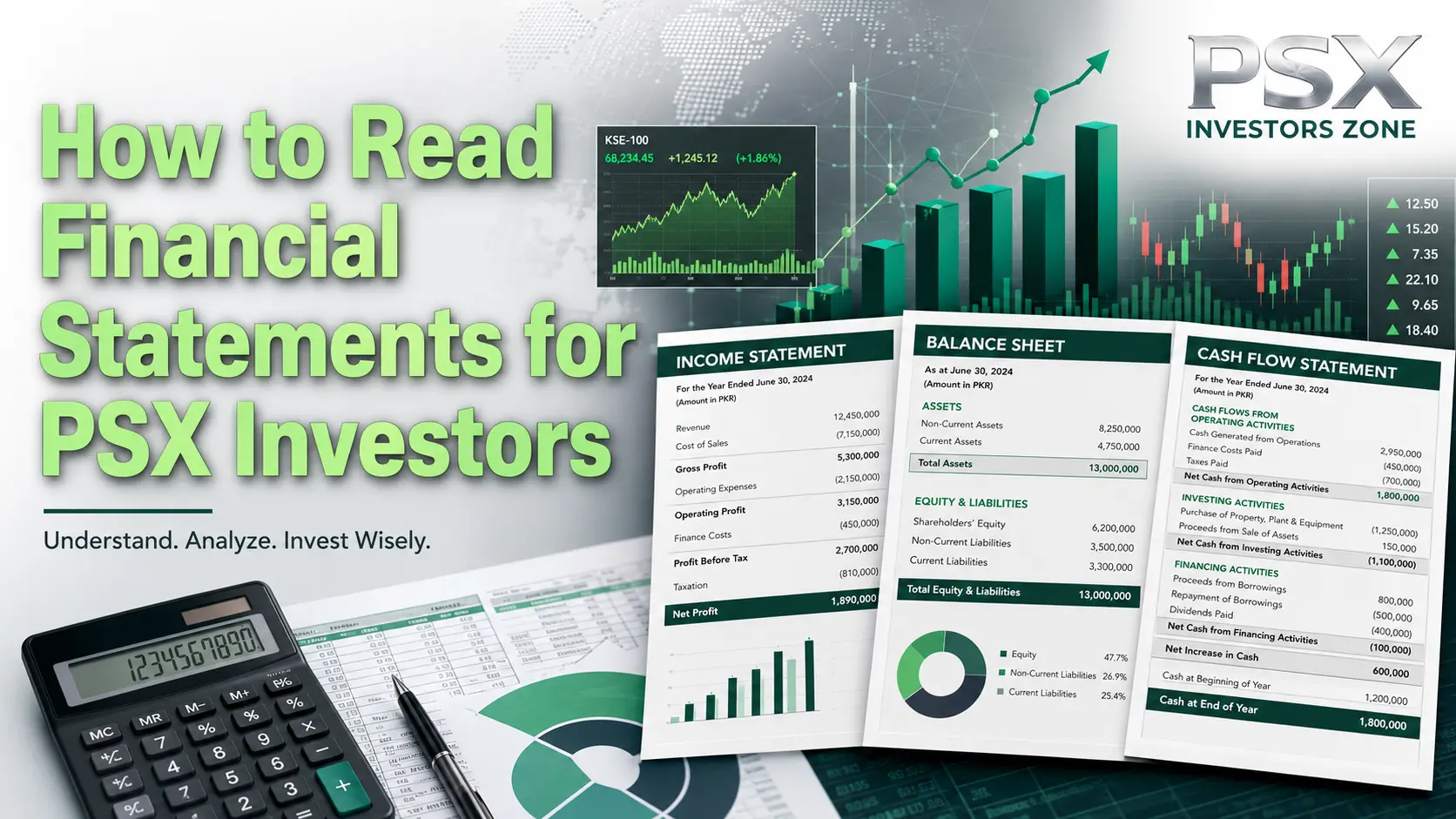
The Income Statement (also called the Profit and Loss Statement) shows how much revenue a company earned and how much profit or loss it generated during a specific period.
Key items include:
- Revenue
- Cost of Sales
- Gross Profit
- Operating Expenses
- Operating Profit
- Finance Costs
- Profit Before Tax
- Net Profit
Why It Matters
A consistently growing and profitable company may indicate improving business performance, though investors should always consider other financial and operational factors as well.
2. Balance Sheet
The Balance Sheet shows what a company owns and what it owes at a specific point in time.
It consists of three main sections:
Assets
Everything the company owns.
Examples include:
- Cash
- Inventory
- Property
- Equipment
- Investments
Liabilities
Everything the company owes.
Examples include:
- Bank loans
- Trade payables
- Other obligations
Shareholders' Equity
The value remaining for shareholders after liabilities are deducted from assets.
Why It Matters
A strong balance sheet may indicate financial stability and the ability to withstand challenging business conditions.
3. Cash Flow Statement
The Cash Flow Statement tracks how cash moves into and out of the business.
It includes:
Operating Activities
Cash generated from the company's core business operations.
Investing Activities
Cash used for purchasing assets or received from selling investments.
Financing Activities
Cash received from or paid to shareholders and lenders.
Why It Matters
A profitable company isn't always generating positive cash flow. Reviewing cash flow helps investors assess whether profits are supported by actual cash generation.
Financial Ratios Every Beginner Should Know
While financial statements provide raw data, financial ratios help investors interpret that information.
Some commonly used ratios include:
- Earnings Per Share (EPS)
- Price-to-Earnings (P/E) Ratio
- Return on Equity (ROE)
- Debt-to-Equity Ratio
- Book Value Per Share
- Current Ratio
Each ratio provides a different perspective on a company's financial performance and position.
What Should Investors Look For?
When reviewing financial statements, consider:
- Consistent revenue growth.
- Sustainable profitability.
- Healthy cash flow.
- Reasonable debt levels.
- Efficient use of shareholder capital.
- Stable financial position.
No single number tells the whole story. Always evaluate the company as a whole.
Common Mistakes Beginners Make
Looking Only at Profit
A company may report profits while facing cash flow challenges or increasing debt.
Ignoring Multiple Years
Reviewing only one year's financial statements can provide an incomplete picture.
Compare performance over several years to identify trends.
Comparing Different Industries
Financial ratios vary across industries.
It's generally more meaningful to compare companies operating in the same sector.
Where Can You Find Financial Statements?
Financial statements are commonly available through:
- Company annual reports
- Company quarterly reports
- Official company investor relations pages
- Pakistan Stock Exchange disclosures
Always rely on official sources when reviewing financial information.
How PSX Investors Zone Helps Investors
Learning financial statements is the foundation of fundamental analysis.
Our educational resources also cover:
- Pakistan Stock Exchange Basics
- Stock Brokers
- CDC Accounts
- NCCPL
- Fundamental Analysis
- Technical Analysis
- Shariah-Compliant Investing
- Risk Management
- Long-Term Investing
Our mission is to help investors make informed decisions through education rather than speculation.
Key Takeaways
- Financial statements help investors understand a company's financial health.
- The Income Statement measures profitability.
- The Balance Sheet shows assets, liabilities, and equity.
- The Cash Flow Statement explains how cash moves through the business.
- Reviewing financial statements supports informed investment decisions.
Frequently Asked Questions
What are financial statements?
Financial statements are reports that summarize a company's financial performance and position.
Which financial statement is most important?
Each statement serves a different purpose. Investors often review all three together to gain a more complete understanding of a company's financial condition.
Can beginners learn financial statements?
Yes. With consistent learning and practice, beginners can develop the skills needed to understand company financial reports.
How often do listed companies publish financial statements?
Publicly listed companies publish financial reports according to applicable regulatory requirements, including annual and interim reporting.
Are financial statements enough to make an investment decision?
Financial statements are an important part of research, but investors should also consider business quality, industry conditions, valuation, management, and overall risk before investing.
Conclusion
Understanding financial statements is one of the most valuable skills an investor can develop. Rather than relying on rumors or short-term market movements, financial statements allow you to evaluate businesses based on objective financial information.
As your knowledge grows, you'll be better equipped to analyze companies, identify potential risks, and make informed investment decisions in the Pakistan Stock Exchange.
Educational Disclaimer: This article is intended for educational purposes only and does not constitute financial, investment, legal, tax, or Shariah advice. Investors should conduct their own research and consult qualified professionals before making investment decisions.