Is Investing in Pakistan Stock Exchange (PSX) Halal? A Complete Guide
Introduction
A common question among Muslim investors in Pakistan is:
Is investing in the Pakistan Stock Exchange (PSX) halal?
The short answer is: some PSX investments can be Shariah-compliant, but not every stock listed on PSX is automatically halal.
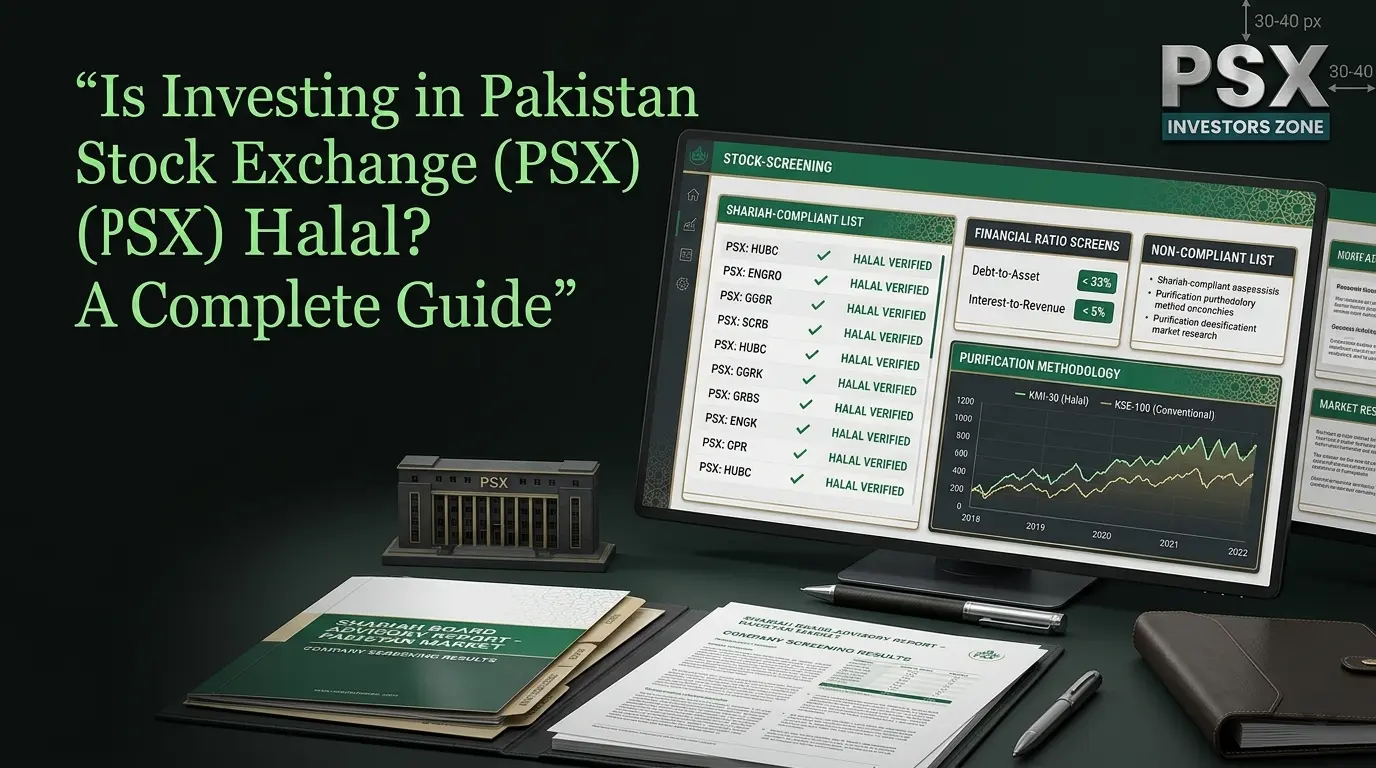
Pakistan Stock Exchange provides dedicated Shariah-compliant investment options and Islamic indices, including the PSX-KMI All Share Index and KMI 30 Index. PSX states that its KMI All Share Index consists of Shariah-compliant companies, while KMI 30 tracks the 30 most liquid Shariah-compliant companies. :contentReference[oaicite:0]{index=0}
Therefore, the important question is not simply whether the stock market is halal or haram.
The better question is:
"Does the specific company and investment meet the applicable Shariah requirements?"
This guide explains the basic principles investors should understand before investing in PSX from a Shariah perspective.
Important: This article is educational and does not issue a personal religious ruling or fatwa. Shariah interpretations and screening methodologies can differ. Investors seeking a religious ruling for their individual circumstances should consult a qualified Shariah scholar.
Is Investing in PSX Halal?
Investing in shares of a company can be permissible under Shariah when the company's business activities and financial characteristics satisfy the applicable Shariah requirements.
However, buying shares of a company involved in prohibited activities or one that fails the relevant Shariah financial screening criteria would not meet the applicable Shariah-compliant investment framework.
This means:
PSX itself is not automatically halal or haram.
Instead, individual securities need to be evaluated.
PSX itself provides dedicated Islamic indices and investment products to help investors identify securities that have passed the applicable Shariah screening process. :contentReference[oaicite:1]{index=1}
What Makes a Stock Shariah-Compliant?
Shariah screening generally looks at two major areas:
- The company's business activities
- The company's financial characteristics
A company should have a permissible core business and satisfy the applicable financial screening thresholds.
The PSX-KMI All Share methodology includes business-activity screening as well as financial ratio screening. :contentReference[oaicite:2]{index=2}
This is why simply looking at whether a company is profitable is not enough to determine whether its shares are Shariah-compliant.
1. The Company's Core Business Matters
The first question is:
What does the company actually do?
Under the PSX Shariah screening framework, businesses involving prohibited activities are excluded.
The published PSX methodology identifies activities such as conventional interest-based financial services, liquor, pork or haram meat, gambling and other impermissible activities as non-compliant. It also identifies tobacco and explosives for exclusion on ethical grounds. :contentReference[oaicite:3]{index=3}
Therefore, investors should understand the company's actual business model before buying its shares.
2. Interest-Bearing Debt Is Considered
A company may have a permissible business but still need to pass financial screening.
One important factor is its level of interest-bearing debt.
In February 2026, SECP approved revised Shariah screening criteria for the PSX-KMI All Share Index.
The revised framework reduced the interest-bearing debt-to-total-assets threshold from 37% to 33%. :contentReference[oaicite:4]{index=4}
This change is particularly important for investors using older information.
Do not rely on outdated 37% screening information when discussing the revised framework.
The revised methodology is scheduled to be implemented from the November 2026 recomposition, based on June 2026 financial data. :contentReference[oaicite:5]{index=5}
3. Non-Compliant Investments Are Screened
Shariah screening also considers a company's investments in non-compliant financial instruments.
The historical PSX methodology includes a screening test for non-compliant investments to total assets. :contentReference[oaicite:6]{index=6}
Examples of instruments identified in the methodology include conventional interest-bearing deposits and certain conventional debt instruments.
The exact thresholds and methodology can change, so investors should always check the latest approved screening framework rather than relying on old articles.
4. Non-Compliant Income Matters
A company's income composition can also be relevant to Shariah screening.
The revised 2026 framework introduced a Shariah compliance rating mechanism that considers debt, investment and income ratios.
PSX's February 2026 notice provides three compliance-rating levels:
- ★★★★★ — non-compliant debt, investment and income ratios at 0%
- ★★★★ — debt and investment ratios below 11%, income ratio below 2%
- ★★★ — debt and investment ratios below 22%, income ratio below 4%
These ratings are designed to provide additional qualitative information about the level of Shariah compliance. :contentReference[oaicite:7]{index=7}
What Is the PSX-KMI All Share Index?
The PSX-KMI All Share Index is one of the most important references for investors looking for Shariah-compliant shares in Pakistan.
PSX describes it as an index comprising Shariah-compliant companies listed on the Pakistan Stock Exchange. :contentReference[oaicite:8]{index=8}
It was developed by Pakistan Stock Exchange and Meezan Bank Limited. :contentReference[oaicite:9]{index=9}
For a Shariah-conscious investor, checking the latest KMI All Share composition can be a useful starting point when researching potential investments.
What Is the KMI 30 Index?
The KMI 30 Index tracks the 30 most liquid Shariah-compliant companies listed on PSX.
PSX states that the index uses float-adjusted market capitalization for weighting and has a 12% cap on the weight of an individual company. :contentReference[oaicite:10]{index=10}
However, investors should understand that:
KMI 30 is an index, not a guarantee of investment quality or future returns.
A company can be Shariah-compliant while still carrying normal business risks, valuation risks and market volatility.
Is Every Stock in KSE-100 Halal?
No.
The KSE-100 Index is a broad market index and should not automatically be treated as a list of Shariah-compliant stocks.
PSX separately maintains Islamic indices, including:
- PSX-KMI All Share Index
- KMI 30
- Meezan Pakistan Index
PSX identifies these as Shariah-compliant indices. :contentReference[oaicite:11]{index=11}
Therefore, investors interested specifically in Shariah-compliant investing should check the applicable Islamic screening status rather than assuming that inclusion in KSE-100 means a company is Shariah-compliant.
How to Check If a PSX Stock Is Shariah-Compliant
Before investing, follow a structured process.
Step 1: Check the Latest Shariah Status
Start by checking the latest official Shariah-compliant securities information published through PSX and relevant regulatory sources.
Do not depend on an old social-media post or an outdated stock list.
Step 2: Check the Company's Business
Understand:
- What products does it sell?
- What services does it provide?
- What industry does it operate in?
- Does its core business involve prohibited activities?
Step 3: Review Financial Screening
Look at relevant:
- Interest-bearing debt
- Non-compliant investments
- Non-compliant income
- Other applicable financial ratios
Step 4: Check the Latest Recomposition
Shariah status can change.
A company that previously passed the screening may not necessarily remain compliant indefinitely.
Step 5: Research the Company Separately
Shariah compliance is only one part of investment research.
You should also analyze:
- Revenue growth
- Earnings
- Cash flow
- Debt
- Profit margins
- ROE
- Valuation
- Dividend history
- Competitive position
- Business risks
Can a Shariah-Compliant Stock Become Non-Compliant?
Yes.
A company's financial position and business circumstances can change.
For example, its:
- Debt level may increase
- Non-compliant investments may change
- Income composition may change
- Business activities may change
Consequently, Shariah status should not be treated as permanent.
PSX's investor guidelines specifically advise investors to review the updated PSX-KMI All Share Index when securities are reclassified. :contentReference[oaicite:12]{index=12}
This is an important principle:
Check before buying — and continue monitoring after buying.
How Often Are Shariah Stocks Reviewed?
Historically, PSX's investor guidance stated that Shariah-compliant indices were recomposed on a semi-annual basis. :contentReference[oaicite:13]{index=13}
However, the 2026 regulatory changes are important.
SECP has advised PSX to consider further enhancements, including the possibility of quarterly index updates, while the February 2026 PSX notice specifies implementation of the revised methodology from the November 2026 recomposition. :contentReference[oaicite:14]{index=14}
Therefore, investors should always check the latest official PSX notice and current index composition rather than relying on a fixed historical review schedule.
What Should You Do If a Stock Loses Its Shariah Status?
This situation requires careful attention.
PSX's investor guidelines explain that investors should review the updated KMI All Share Index when a security is reclassified.
The guidance provides specific treatment depending on the price of the security relative to the original investment cost and explains how investors should handle gains or losses following reclassification. :contentReference[oaicite:15]{index=15}
Because individual circumstances can differ, investors should review the latest official guidance and consult a qualified Shariah advisor where necessary.
Is Stock Trading Halal?
The permissibility of buying and selling shares depends on the nature of the security, the underlying company and the manner in which the transactions are conducted.
Owning shares in a Shariah-compliant company is conceptually different from engaging in activities that may involve prohibited elements.
For a Shariah-conscious investor, the focus should therefore be on:
Permissible company + Shariah-compliant financial profile + permissible investment method
rather than simply asking whether "stock trading" as a broad category is halal.
What About Day Trading?
Short-term trading raises additional Shariah considerations.
The permissibility of specific trading practices can depend on factors such as:
- Ownership
- Settlement
- Short selling
- Borrowing
- Interest
- Leverage
- Derivatives
- Contract structure
Therefore, investors should not assume that every conventional trading strategy is automatically permissible simply because the underlying company is Shariah-compliant.
For religious certainty regarding a particular trading strategy, consult a qualified Shariah scholar.
Is Margin Trading Halal?
Investors should be particularly careful with margin or leveraged trading.
If an arrangement involves interest or other prohibited contractual elements, it may not satisfy Shariah requirements.
The fact that the underlying stock is Shariah-compliant does not automatically make every method of financing or trading it permissible.
Investors interested in Shariah-compliant investing should understand the complete transaction structure, not just the company's stock classification.
What About Short Selling?
Short selling involves a different transaction structure from simply buying and owning shares.
Because Shariah principles concerning ownership and sale of assets are relevant, investors should not assume that conventional short-selling arrangements are permissible.
Anyone considering such strategies should obtain specific guidance from a qualified Shariah scholar.
What About Dividends From Shariah-Compliant Stocks?
Dividends can be received from shares of companies that satisfy the applicable Shariah screening methodology.
However, investors should understand the concept of purification where applicable.
If a Shariah-compliant company has a small amount of income that is considered non-compliant under the relevant screening methodology, the applicable Shariah framework may require purification of the corresponding portion.
The exact purification methodology should be obtained from the relevant Shariah advisor or approved framework.
Does Shariah Compliance Mean the Stock Is a Good Investment?
No.
This is one of the most important points for new investors.
Shariah-compliant does not mean guaranteed profit.
A stock can satisfy Shariah requirements and still:
- Lose value
- Have weak earnings
- Be overvalued
- Face intense competition
- Cut its dividend
- Experience declining cash flow
- Carry business risks
Shariah screening answers an important question:
"Is this investment compatible with the applicable Shariah criteria?"
It does not answer:
"Will this stock make money?"
Those are two different questions.
Shariah Compliance vs Investment Quality
A disciplined investor should evaluate both.
Shariah Analysis
Ask:
- Is the business permissible?
- Does the company pass the latest screening?
- Are its financial ratios within the applicable thresholds?
- Is the latest Shariah status confirmed?
Investment Analysis
Then ask:
- Is revenue growing?
- Are earnings sustainable?
- Is cash flow healthy?
- Is debt manageable?
- Is the stock fairly valued?
- Does the company have competitive advantages?
- What are the major risks?
The strongest research process considers both dimensions.
A Simple Shariah Stock Checklist
Before buying a PSX stock, ask:
1. Is the company's core business permissible?
2. Is the company currently included in the applicable Shariah-compliant list?
3. Does it satisfy the latest financial screening criteria?
4. What is its interest-bearing debt position?
5. What are its non-compliant investments?
6. What is its non-compliant income ratio?
7. What is the latest Shariah rating, where applicable?
8. Has the company recently been reclassified?
9. Is the stock financially strong?
10. Is the valuation reasonable?
11. What are the company's major risks?
12. Does the investment method itself comply with your Shariah requirements?
2026 Shariah Screening Changes Investors Should Know
The Shariah-screening framework changed in 2026.
SECP approved revisions to the PSX-KMI All Share Index methodology in February 2026.
One major change was the reduction of the interest-bearing debt-to-total-assets threshold:
37% → 33%
The revised framework also introduced a three-star, four-star and five-star Shariah compliance rating system based on specified debt, investment and income ratios. :contentReference[oaicite:16]{index=16}
The changes are scheduled for implementation from the November 2026 recomposition using June 2026 financial data. :contentReference[oaicite:17]{index=17}
This means older articles listing the 37% debt threshold may become outdated for the revised framework.
Why You Should Not Use Old "Halal Stock" Lists
A list published several years ago may no longer accurately represent current Shariah status.
Companies change.
Financial statements change.
Debt levels change.
Business activities change.
Screening methodologies can also change.
The 2026 revision of the KMI methodology is a good example of why investors should verify current information. :contentReference[oaicite:18]{index=18}
Always check the latest official information before investing.
Where Can You Find Shariah-Compliant PSX Stocks?
PSX provides dedicated Islamic-market resources.
The PSX-KMI All Share Index covers Shariah-compliant companies, while the KMI 30 Index tracks 30 of the most liquid Shariah-compliant companies. :contentReference[oaicite:19]{index=19}
PSX also lists other Shariah-compliant investment products, including:
- Meezan Pakistan ETF
- Sukuk
- Modarabas
- Islamic mutual funds
PSX describes these as options for investors seeking Shariah-compliant instruments. :contentReference[oaicite:20]{index=20}
Can You Build Long-Term Wealth With Halal Investing?
Yes, Shariah-compliant investing can be approached as a long-term wealth-building strategy.
But there is no guaranteed return.
Long-term wealth creation generally requires:
- Consistent investing
- Quality businesses
- Reasonable valuations
- Reinvestment
- Patience
- Risk management
- Diversification
- Continuous research
For a Shariah-conscious investor, these principles can be combined with appropriate Shariah screening.
The objective should not be to find a stock simply because it is labeled "halal."
The objective is to find a Shariah-compliant business that is also financially attractive at a reasonable valuation.
Common Mistakes Shariah-Conscious Investors Make
Mistake 1: Assuming Every PSX Stock Is Halal
PSX contains both Shariah-compliant and non-compliant securities.
Mistake 2: Checking Only the Company's Industry
A permissible business can still fail financial screening.
Mistake 3: Using an Old KMI List
Shariah status can change.
Mistake 4: Assuming KSE-100 Means Halal
KSE-100 is not the dedicated Islamic index.
Mistake 5: Ignoring the Investment Method
The company's status and the structure of the transaction are separate considerations.
Mistake 6: Thinking Shariah Compliance Guarantees Profit
It does not.
Mistake 7: Ignoring Valuation
A Shariah-compliant company can still be overpriced.
Mistake 8: Ignoring Business Quality
Screening is only the beginning of investment research.
Is PSX Suitable for Shariah-Conscious Investors?
PSX has developed a significant Islamic investment infrastructure.
According to PSX, more than 50% of the market comprises Shariah-compliant companies, and the exchange provides Islamic indices and products for investors focused on Islamic principles. :contentReference[oaicite:21]{index=21}
This means investors seeking Shariah-compliant opportunities do not necessarily have to avoid the stock market altogether.
Instead, they can use the available Islamic screening framework to identify eligible securities and then conduct their own investment research.
A Better Way to Think About Halal PSX Investing
Instead of asking only:
"Is PSX halal?"
Break the question into four parts:
1. Is the Business Halal?
Does the company operate a permissible business?
2. Does the Company Pass Shariah Screening?
Does it satisfy the latest applicable financial criteria?
3. Is the Investment Method Halal?
Are you avoiding prohibited financing and trading structures?
4. Is It a Good Investment?
Does the company have strong fundamentals and a reasonable valuation?
This four-step approach creates a much more disciplined framework for Shariah-conscious investing.
Key Takeaways
- Investing in PSX is not automatically halal or haram as a whole; individual securities and transaction structures need to be assessed.
- PSX provides dedicated Shariah-compliant indices and investment products. :contentReference[oaicite:22]{index=22}
- The PSX-KMI All Share Index represents Shariah-compliant companies under the applicable screening methodology. :contentReference[oaicite:23]{index=23}
- KMI 30 tracks 30 of the most liquid Shariah-compliant companies listed on PSX. :contentReference[oaicite:24]{index=24}
- Business activity is an important part of Shariah screening.
- Financial ratios such as interest-bearing debt, non-compliant investments and non-compliant income are also considered.
- In 2026, SECP approved a revised KMI screening framework that reduces the interest-bearing debt-to-total-assets threshold from 37% to 33%. :contentReference[oaicite:25]{index=25}
- The revised framework also introduces Shariah compliance ratings of three, four and five stars. :contentReference[oaicite:26]{index=26}
- The revised methodology is scheduled for implementation from the November 2026 recomposition. :contentReference[oaicite:27]{index=27}
- Shariah status can change, so investors should check current official information.
- Shariah compliance does not guarantee profit or make a stock a good investment.
- Investors should combine Shariah screening with fundamental and valuation analysis.
- Margin, short selling, leverage and other trading methods require separate Shariah consideration.
- For individual religious rulings, investors should consult a qualified Shariah scholar.
Frequently Asked Questions
Is investing in PSX halal?
Some PSX investments can be Shariah-compliant, but not every PSX-listed security is automatically halal. Investors should check the company's business activity, financial screening and the structure of the investment.
Are all PSX shares halal?
No. PSX includes securities that may not meet Shariah requirements. PSX maintains dedicated Islamic indices, including the PSX-KMI All Share Index and KMI 30, for Shariah-compliant securities. :contentReference[oaicite:28]{index=28}
How do I know if a PSX stock is halal?
Check the latest official Shariah-compliant securities information and the applicable KMI screening methodology. Then independently research the company's business and financial position.
Is KSE-100 Shariah-compliant?
KSE-100 is a broad market index and should not automatically be considered Shariah-compliant. Investors specifically seeking Shariah-compliant companies should refer to the applicable Islamic indices.
What is KMI 30?
KMI 30 is an Islamic index tracking 30 of the most liquid Shariah-compliant companies listed on PSX. :contentReference[oaicite:29]{index=29}
What is PSX-KMI All Share Index?
It is an index comprising Shariah-compliant companies listed on PSX under the applicable approved screening methodology. :contentReference[oaicite:30]{index=30}
Can a stock become non-Shariah-compliant?
Yes. A company's business activities or financial position can change, and screening methodologies can also be revised. Investors should monitor the latest official status.
What changed in the Shariah screening criteria in 2026?
SECP approved a revised methodology that reduces the interest-bearing debt-to-total-assets threshold from 37% to 33% and introduces a three-to-five-star Shariah compliance rating system. :contentReference[oaicite:31]{index=31}
Does Shariah-compliant mean the stock will be profitable?
No. Shariah compliance does not guarantee returns. Investors still need to analyze profitability, cash flow, valuation, debt, management and business risks.
Are dividends from Shariah-compliant stocks halal?
Dividends from shares that meet the applicable Shariah framework can be permissible, subject to the relevant Shariah rules and any required purification process. Investors should follow the guidance of the applicable Shariah advisor or scholar.
Is day trading halal?
The answer can depend on the specific transaction structure, ownership, settlement and other factors. Investors should obtain specific Shariah guidance rather than assuming that every short-term trading strategy is permissible.
Is margin trading halal?
If margin financing involves interest or other prohibited elements, it may not satisfy Shariah requirements. The specific contract should be reviewed by a qualified Shariah scholar.
Conclusion
Is investing in the Pakistan Stock Exchange halal?
The answer is more nuanced than simply saying yes or no.
PSX provides a substantial Shariah-compliant investment framework, including the PSX-KMI All Share Index, KMI 30 and other Islamic investment products. :contentReference[oaicite:32]{index=32}
But investors should remember:
Not every stock on PSX is automatically Shariah-compliant.
A responsible Shariah-conscious investor should examine:
Business Activity → Shariah Screening → Investment Structure → Financial Quality → Valuation
The 2026 changes to the KMI screening methodology make it even more important to use current official information rather than old stock lists or outdated screening ratios. :contentReference[oaicite:33]{index=33}
And perhaps the most important point:
Halal does not mean guaranteed profit.
Shariah compliance and investment quality are two separate dimensions.
At PSX Investors Zone, our focus is on helping investors understand PSX, financial analysis and Shariah-compliant investing in a simple and practical way.
Educational & Shariah Disclaimer: This article is provided for educational and informational purposes only. It is not a fatwa, religious ruling, financial advice, investment recommendation, legal advice or tax advice. Shariah interpretations and screening methodologies may differ between scholars and institutions. Investors should verify the latest official Shariah-compliance status and consult a qualified Shariah scholar for religious guidance concerning their individual circumstances. Investing in shares involves market risk and does not guarantee profit.