Top Financial Ratios Every PSX Investor Should Know: A Beginner's Guide
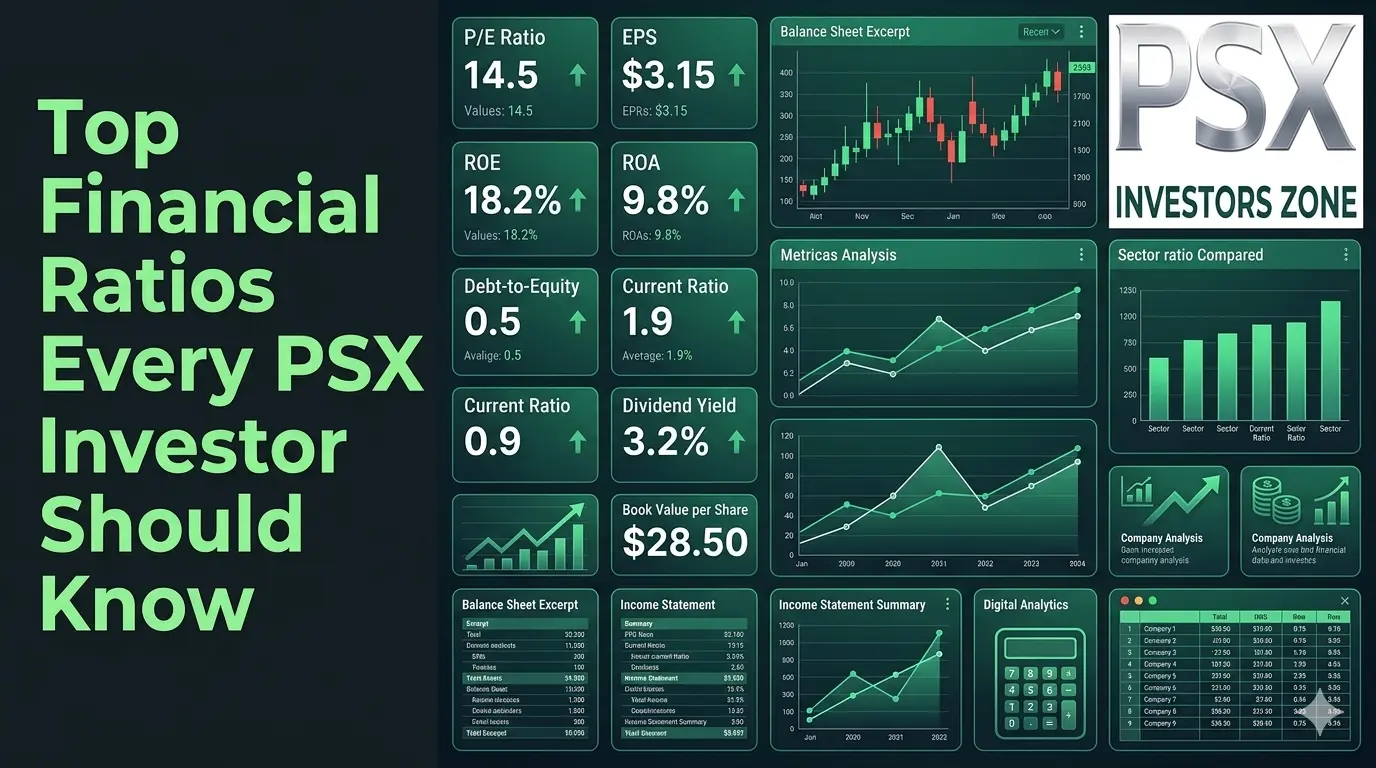
Successful investing is not about buying stocks based on rumors or short-term price movements. It begins with understanding the financial strength of a business.
One of the most effective ways to evaluate a company listed on the Pakistan Stock Exchange (PSX) is by using financial ratios. These ratios help investors compare companies, assess financial performance, identify risks, and make informed investment decisions.
At PSX Investors Zone, we believe that financial ratios should support your research—not replace it. They provide valuable insights but should always be interpreted alongside financial statements, business quality, industry conditions, and long-term prospects.
This guide introduces the key financial ratios every beginner investor should understand.
What Are Financial Ratios?
Financial ratios are calculations derived from a company's financial statements.
They help investors answer questions such as:
- Is the company profitable?
- Is the stock reasonably valued?
- Can the company manage its debt?
- Is management using shareholders' money efficiently?
- Does the company generate enough cash?
- Is the dividend sustainable?
Rather than relying on a single ratio, investors should analyze multiple ratios together to gain a balanced view.
1. Price-to-Earnings (P/E) Ratio
What It Measures
The P/E ratio compares a company's share price with its earnings per share (EPS).
Why It Matters
It helps investors assess how the market values a company's earnings.
A relatively lower P/E may indicate:
- Attractive valuation
- Lower market expectations
- Potential investment opportunities
A higher P/E may indicate:
- Strong growth expectations
- Premium valuation
- Greater investor optimism
A P/E ratio should always be compared with companies in the same industry.
2. Earnings Per Share (EPS)
What It Measures
EPS shows how much profit is attributable to each outstanding share.
Why It Matters
Growing EPS over several years may indicate improving profitability.
When reviewing EPS:
- Look for consistent growth.
- Compare historical performance.
- Evaluate alongside revenue and cash flow.
EPS alone should never determine an investment decision.
3. Return on Equity (ROE)
What It Measures
ROE indicates how efficiently a company uses shareholders' equity to generate profits.
Why It Matters
Companies with consistently healthy ROE often demonstrate effective capital management.
Always compare ROE with competitors in the same industry.
4. Debt-to-Equity Ratio
What It Measures
This ratio compares a company's total debt with shareholders' equity.
Why It Matters
Debt can support business growth, but excessive leverage increases financial risk.
Generally, investors prefer companies with debt levels that are manageable relative to their industry and business model.
5. Current Ratio
What It Measures
The Current Ratio evaluates a company's ability to meet its short-term obligations using its short-term assets.
Why It Matters
A healthy current ratio may indicate good liquidity and financial flexibility.
Extremely high or low values should be interpreted in the context of the company's industry.
6. Net Profit Margin
What It Measures
Net Profit Margin shows how much of each rupee of revenue remains as profit after expenses.
Why It Matters
Higher and consistent profit margins often indicate efficient business operations and pricing power.
Compare profit margins with industry peers rather than companies in unrelated sectors.
7. Return on Assets (ROA)
What It Measures
ROA measures how efficiently a company uses its assets to generate profits.
Why It Matters
A higher ROA may indicate that management is using company assets effectively.
This ratio is particularly useful for comparing companies within asset-intensive industries.
8. Dividend Yield
What It Measures
Dividend Yield compares a company's annual dividend with its current share price.
Why It Matters
It helps income-focused investors evaluate potential cash returns.
However, an unusually high dividend yield may also warrant further investigation into the company's financial health.
9. Book Value Per Share (BVPS)
What It Measures
Book Value Per Share represents the company's net assets allocated to each outstanding share.
Why It Matters
Investors often compare book value with market price when assessing valuation.
Book value is especially relevant for banks and asset-heavy businesses.
10. Operating Cash Flow
What It Measures
Operating Cash Flow reflects the cash generated from a company's core business operations.
Why It Matters
Profits reported in the income statement should ideally be supported by healthy operating cash flow.
Strong cash generation can support business expansion, debt repayment, and dividend payments.
Why One Ratio Is Never Enough
No financial ratio tells the complete story.
For example:
- A low P/E ratio may indicate an attractive valuation—or underlying business problems.
- A high ROE may result from excessive borrowing.
- A high dividend yield may not be sustainable.
Always analyze multiple financial indicators together.
Compare Companies Within the Same Industry
Financial ratios vary significantly across industries.
Instead of comparing:
❌ A bank with a cement company
Compare:
✅ Two banks
✅ Two fertilizer companies
✅ Two technology companies
Industry comparisons provide more meaningful insights.
Combine Ratios with Business Analysis
Financial ratios should be part of a broader investment process.
Also evaluate:
- Business model
- Revenue growth
- Competitive advantages
- Management quality
- Industry outlook
- Corporate governance
- Economic conditions
- Shariah compliance (if applicable)
Strong investment decisions require both quantitative and qualitative analysis.
Common Mistakes Investors Make
Relying on a Single Ratio
No individual ratio provides a complete assessment of a company.
Ignoring Financial Statements
Ratios summarize financial information, but investors should also review the Income Statement, Balance Sheet, and Cash Flow Statement.
Comparing Different Industries
Financial structures vary significantly between sectors.
Always compare similar businesses.
Ignoring Long-Term Trends
Review several years of financial performance rather than focusing on a single reporting period.
Financial Ratio Checklist
Before investing, ask yourself:
✅ Is the company profitable?
✅ Is EPS growing consistently?
✅ Is ROE healthy?
✅ Is debt manageable?
✅ Is operating cash flow positive?
✅ Is the valuation reasonable?
✅ Does the company have sustainable margins?
✅ How does it compare with competitors?
How PSX Investors Zone Helps Investors
We publish practical educational content to help investors understand:
- Financial Statements
- Company Analysis
- Fundamental Analysis
- Technical Analysis
- Portfolio Diversification
- Risk Management
- Shariah-Compliant Investing
- Pakistan Stock Exchange Basics
Our objective is to help investors make informed decisions through education and disciplined research.
Key Takeaways
- Financial ratios simplify company analysis.
- Use multiple ratios together rather than relying on a single metric.
- Compare companies within the same industry.
- Review financial statements alongside ratio analysis.
- Consider qualitative factors such as management, business model, and industry outlook.
- Financial ratios support informed investment decisions but do not guarantee future performance.
Frequently Asked Questions
Which financial ratio is most important?
There is no single "best" ratio. Investors often use a combination of P/E, EPS, ROE, Debt-to-Equity, Current Ratio, and Operating Cash Flow to evaluate companies.
Can financial ratios predict future stock prices?
No. Financial ratios provide insights into a company's financial condition but cannot predict future market performance.
Should beginners learn financial ratios?
Yes. Understanding basic financial ratios helps investors analyze companies more effectively and make research-based decisions.
Why should I compare companies within the same industry?
Different industries have different business models, profit margins, and capital structures. Comparing similar companies provides more meaningful insights.
Are financial ratios enough before investing?
No. Investors should also evaluate financial statements, management quality, industry trends, corporate governance, and overall business fundamentals.
Conclusion
Financial ratios are valuable tools for understanding the financial health and valuation of companies listed on the Pakistan Stock Exchange. They help investors compare businesses, identify strengths and weaknesses, and support informed decision-making.
However, successful investing is not about finding one perfect ratio. It is about combining financial analysis with a clear understanding of the business, its industry, and long-term prospects.
By learning how to interpret financial ratios correctly, you can become a more confident and disciplined investor.
Educational Disclaimer: This article is for educational purposes only and does not constitute financial, investment, legal, tax, or Shariah advice. Investing in the Pakistan Stock Exchange involves risk, including the potential loss of capital. Always conduct your own research and consult qualified professionals before making investment decisions.