What Is a Bonus Share in PSX? A Complete Guide for Beginners
What Is a Bonus Share?
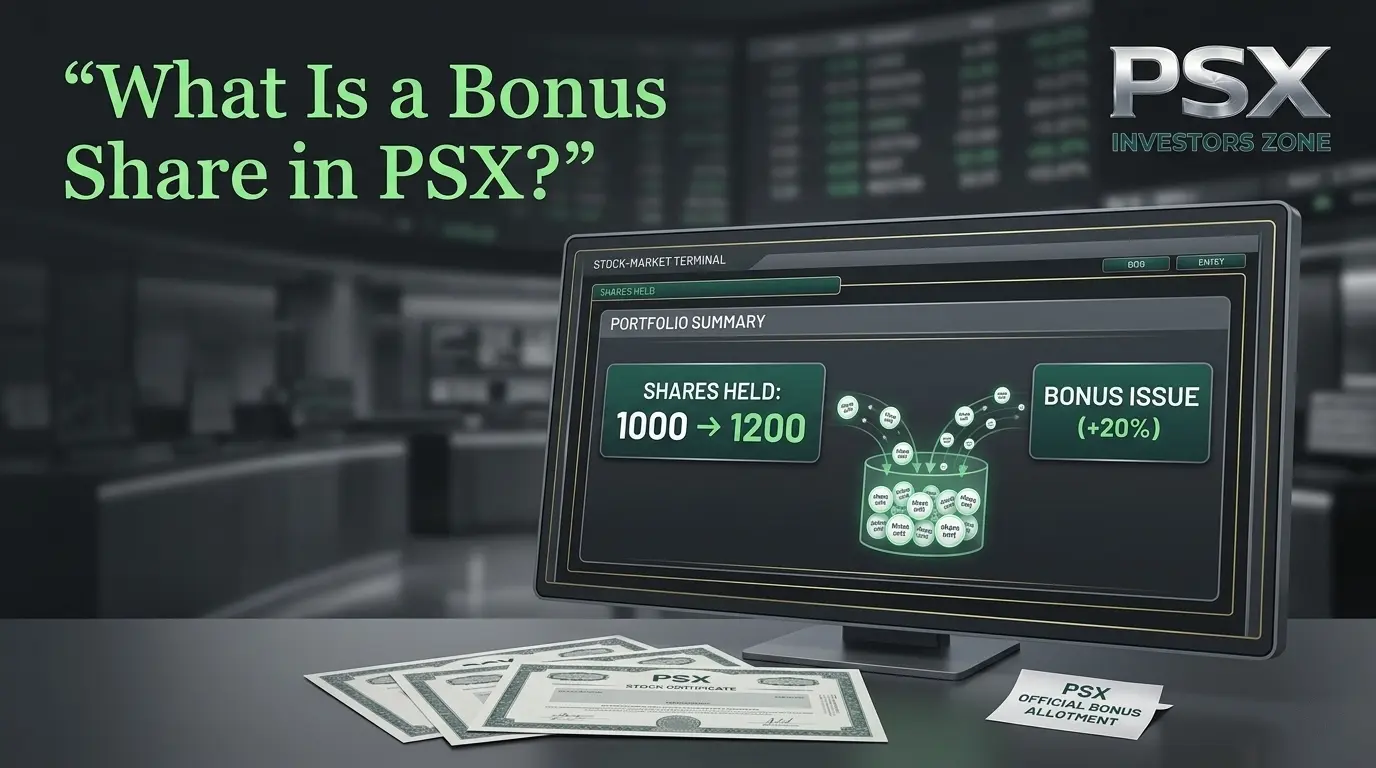
A bonus share is an additional share given by a company to its existing shareholders without requiring them to make an additional payment. In the Pakistan Stock Exchange (PSX), companies may issue bonus shares from eligible reserves or accumulated profits as part of a corporate action.
For example, if a company announces a 10% bonus, an eligible shareholder may receive 10 additional shares for every 100 shares already held, subject to the company's approved terms.
Bonus shares increase the number of shares an investor owns, but they do not automatically create additional wealth because the market price can adjust after the bonus issue.
How Do Bonus Shares Work in PSX?
When a listed company announces a bonus issue, it generally communicates the relevant terms and important dates through the applicable regulatory and exchange process.
The key dates investors should understand include:
- Announcement date: The company announces the proposed bonus issue.
- Book closure / record date: The relevant shareholder entitlement is determined according to the applicable corporate-action process.
- Ex-bonus date: The share begins trading without the entitlement to the bonus shares.
- Credit date: Eligible investors receive the bonus shares in their securities accounts after completion of the required processing.
Investors should always check the company's official corporate-action announcement and PSX information for the exact dates and terms.
Bonus Share Example
Suppose you own 1,000 shares of a company and it announces a 10% bonus issue.
Your bonus entitlement would be:
1,000 × 10% = 100 bonus shares
After the bonus shares are credited, your total holding would become:
1,000 + 100 = 1,100 shares
The additional shares do not mean that your investment has automatically increased by 10%. The market price may adjust to reflect the increased number of shares.
How Are Bonus Shares Calculated?
The basic calculation is:
Bonus Shares = Existing Shares × Bonus Percentage
For example:
| Existing Shares | Bonus | Bonus Shares | Total Shares |
|---|---|---|---|
| 500 | 10% | 50 | 550 |
| 1,000 | 20% | 200 | 1,200 |
| 2,000 | 25% | 500 | 2,500 |
The actual entitlement should always be confirmed from the company's announced terms and applicable corporate-action processing.
Why Do Companies Issue Bonus Shares?
Companies may issue bonus shares for several reasons, including:
Rewarding Existing Shareholders
A bonus issue can distribute additional shares to existing shareholders without requiring them to pay for those shares.
Increasing the Number of Shares in Circulation
A bonus issue increases the company's number of outstanding shares, which can affect the market price per share.
Capitalizing Reserves
Bonus shares can be issued by capitalizing eligible reserves or retained earnings, subject to applicable corporate and regulatory requirements.
Improving Share Accessibility
A lower market price after adjustment may make individual shares more accessible to some investors, although the company's underlying value does not automatically increase simply because the number of shares increases.
Do Bonus Shares Increase Your Investment Value?
Not automatically.
Consider an investor holding 1,000 shares at Rs. 100 per share:
Investment value = Rs. 100,000
If the company issues a 10% bonus, the investor may receive another 100 shares, giving a total of 1,100 shares.
If the market price adjusts to approximately Rs. 90.91, then:
1,100 × Rs. 90.91 ≈ Rs. 100,000
This simplified example demonstrates why a bonus issue by itself does not necessarily increase an investor's total market value.
Actual market prices can differ because share prices continue to move based on supply, demand, company fundamentals, market conditions and other factors.
Bonus Shares vs Cash Dividend
Bonus shares and cash dividends are different forms of shareholder distributions.
| Bonus Shares | Cash Dividend |
|---|---|
| Additional shares are issued | Cash is paid to eligible shareholders |
| Increases the number of shares held | Does not increase the number of shares |
| Usually involves capitalization of eligible reserves | Represents a cash distribution |
| Share price may adjust after the bonus | Share price may also react to the dividend |
| No immediate cash payment from the company to the investor | Investor receives cash subject to applicable rules and taxes |
What Is an Ex-Bonus Date?
The ex-bonus date is an important date associated with a bonus issue.
From the ex-bonus date, shares trade without the entitlement to the announced bonus, subject to the applicable settlement and corporate-action rules.
Investors should not rely solely on the trading price displayed on a particular day. They should check the official PSX announcement and corporate-action information to understand the relevant entitlement dates.
Who Is Eligible for Bonus Shares?
Eligibility depends on the company's announced terms and the applicable record-date/corporate-action process.
Investors should check:
- The company's official announcement
- PSX corporate-action information
- Their broker's communication
- CDC account information where applicable
It is important to verify the relevant dates because buying or selling shares around a corporate-action date can affect entitlement.
Are Bonus Shares Free?
From an investor's perspective, bonus shares are generally received without making an additional purchase payment.
However, “free” does not mean that the bonus shares represent an automatic increase in the total economic value of the investment. The share price can adjust because the number of shares outstanding has increased.
Important Things Investors Should Check
Before making any investment decision based on a bonus announcement, investors should consider:
- The company's financial performance.
- The reason for the bonus issue.
- The company's profitability and cash flows.
- The announced bonus percentage.
- The relevant record and ex-bonus dates.
- The company's corporate-action announcement.
- Applicable taxes and regulatory requirements.
- The company's long-term fundamentals rather than focusing only on the bonus percentage.
A bonus announcement alone should not be treated as a reason to buy a stock.
Bonus Shares and Shariah-Compliant Investing
For investors following Shariah-compliant investing principles, receiving a bonus share is a corporate-action matter, but the underlying company's Shariah status and applicable screening methodology remain important.
Investors should verify the company's current Shariah-compliance status using a recognized and applicable screening methodology rather than assuming that every bonus issue is automatically Shariah-compliant.
For religious rulings or specific cases, investors should consult a qualified Shariah advisor.
Final Takeaway
A bonus share in PSX is an additional share distributed to eligible existing shareholders without requiring an additional purchase payment. Bonus issues can increase the number of shares an investor owns, but they do not automatically increase the total value of the investment because the market price may adjust.
Understanding the bonus percentage, entitlement dates, corporate-action process and company fundamentals can help PSX investors better understand what a bonus announcement actually means for their portfolio.