What Is NCCPL and How Does It Work in PSX?
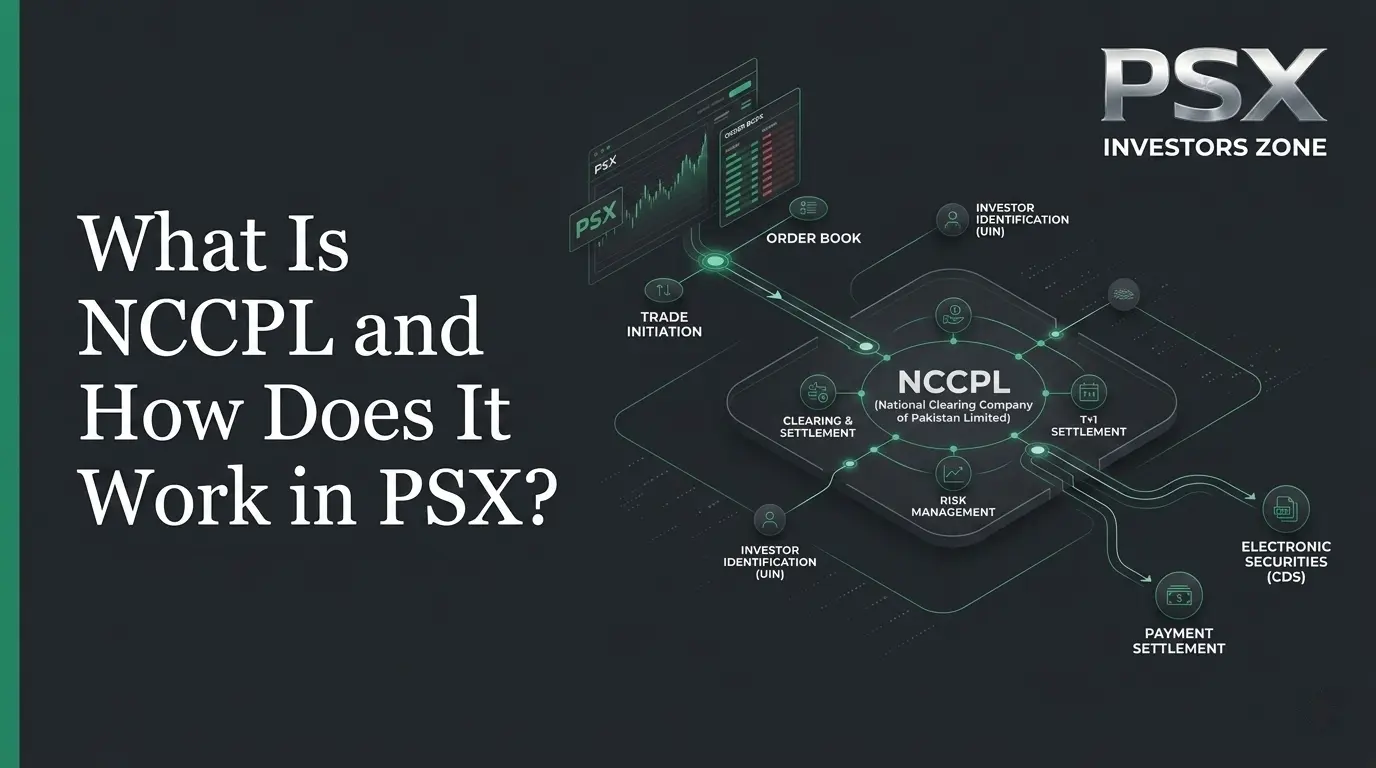
When you buy or sell shares on the Pakistan Stock Exchange, the transaction does not simply end when the trade is executed.
Behind every successful trade is an infrastructure that handles clearing, settlement, risk management and other important processes.
One of the most important institutions responsible for these functions is the National Clearing Company of Pakistan Limited (NCCPL).
For beginners, understanding NCCPL is useful because it explains what happens to your shares and money after you place a trade through your broker.
What Is NCCPL?
NCCPL stands for National Clearing Company of Pakistan Limited.
It is a key institution of Pakistan's capital-market infrastructure responsible for providing clearing, settlement and risk-management services for transactions conducted through the Pakistan Stock Exchange.
NCCPL was incorporated on July 3, 2001, and its National Clearing & Settlement System (NCSS) began live operations on December 24, 2001. It was established to centralize the clearing and settlement functions that had previously been handled separately by Pakistan's three stock exchanges.
In simple terms:
PSX executes the trade, while NCCPL helps make sure the trade is properly cleared and settled.
What Does NCCPL Do?
NCCPL performs several important functions in Pakistan's capital market.
Its major responsibilities include:
Clearing trades Settlement of securities and funds Risk management Acting as a Central Counterparty (CCP) Managing Unique Identification Numbers (UINs) Computing and collecting Capital Gains Tax (CGT) Providing centralized KYC services Supporting certain leveraged-market systems Operating the National Clearing & Settlement System (NCSS)
NCCPL provides clearing and settlement services across several PSX market segments, including the regular/cash market, odd-lot market, derivatives, negotiated deals and debt market.
NCCPL vs PSX vs CDC
Beginners often confuse these three institutions.
Institution Main Role PSX Provides the marketplace where securities are bought and sold NCCPL Handles clearing, settlement and risk management CDC Provides the central depository infrastructure for securities
A simplified way to remember them is:
PSX → Trade
NCCPL → Clear & Settle
CDC → Hold/Transfer Securities
These institutions work together as important parts of Pakistan's capital-market infrastructure.
How Does NCCPL Work After You Buy a Stock?
Let's use a simple example.
Suppose you buy 1,000 shares of a PSX-listed company through your broker.
Step 1: You Place the Order
You place a buy order through your stockbroker.
Step 2: PSX Executes the Trade
If your order matches a seller's order, the trade is executed through the PSX trading system.
Step 3: NCCPL Processes the Trade
The transaction enters NCCPL's clearing and settlement infrastructure.
NCCPL determines the relevant obligations of the parties involved.
Step 4: Clearing
NCCPL calculates the securities and money that need to be delivered by the respective clearing members.
Step 5: Settlement
The buyer provides the required funds and the seller provides the securities.
The securities and money are transferred according to the applicable settlement process.
This is known as Delivery versus Payment (DVP)—the delivery of securities and payment are linked within the settlement process.
What Is T+1 Settlement?
One of the most important recent changes for PSX investors is the move from T+2 to T+1 settlement.
Pakistan's capital market transitioned to T+1 settlement effective February 9, 2026. Under T+1, eligible trades are settled on the next business/trading day rather than two business days after the trade.
For example:
Monday: You buy shares Tuesday: Settlement takes place
The change helps shorten the settlement period and can improve market efficiency and liquidity while reducing settlement exposure.
What Is Clearing?
Clearing is the process of determining what each party owes after a trade.
Imagine:
Investor A buys shares. Investor B sells shares. Multiple trades occur during the day. Different buyers and sellers have different obligations.
Instead of treating every transaction completely independently, the clearing system determines the relevant obligations and facilitates the settlement process.
NCCPL performs this function through its National Clearing & Settlement System (NCSS).
What Is Settlement?
Settlement is the actual completion of the transaction.
This involves transferring:
Securities to the buyer Money to the seller
NCCPL states that transactions are settled through NCSS on a Delivery versus Payment (DVP) basis.
This is why the settlement process is essential to the functioning of an organized stock market.
NCCPL as a Central Counterparty
Another important role of NCCPL is acting as a Central Counterparty (CCP).
In simple terms, NCCPL interposes itself between the original buyer and seller in the clearing process.
Instead of the buyer and seller having to rely directly on each other, the CCP structure helps manage counterparty risk and supports the orderly completion of market transactions. NCCPL assumed its CCP role in May 2016 following the Securities Act, 2015.
This is an important part of maintaining confidence and stability in the market.
What Is NCCPL Risk Management?
Trading creates the possibility that a participant may fail to meet its financial or securities obligations.
NCCPL therefore performs risk-management functions for trades cleared through its systems.
Its infrastructure includes mechanisms designed to manage clearing-member obligations and protect the settlement process. NCCPL also maintains a Settlement Guarantee Fund (SGF) under the applicable regulatory framework.
This does not mean investors are guaranteed profits or protected from investment losses.
Risk management in this context primarily concerns the orderly functioning and settlement of market transactions.
What Is a UIN in NCCPL?
UIN stands for Unique Identification Number.
NCCPL provides a centralized mechanism for registering investors in the clearing and settlement system through UINs.
The purpose is to maintain a traceable connection between investors and their market transactions.
For a PSX investor, the UIN is therefore an important part of the identification and transaction-recording infrastructure.
Does NCCPL Calculate Capital Gains Tax?
Yes.
NCCPL is mandated to compute, determine, collect and deposit Capital Gains Tax (CGT) on the disposal of listed securities under the applicable tax regime.
This is why NCCPL information and reports can be important when investors are reviewing their capital gains and tax obligations.
However, investors should not rely on an old article for current tax rates. Tax rules can change, so always verify the current treatment with NCCPL, FBR or a qualified tax professional.
What Is NCCPL's Centralized KYC Role?
NCCPL also operates a Centralized Know Your Customer (CKO) function.
The purpose is to make investor identification and account-opening processes more standardized and secure within the capital market.
This is another example of NCCPL's role extending beyond simple trade settlement.
Does NCCPL Hold Your Shares?
This is an important distinction.
NCCPL is primarily responsible for clearing, settlement and related infrastructure.
The Central Depository Company (CDC) provides the central depository infrastructure for book-entry securities.
NCCPL does offer a separate National Custodial Services (NCS) facility under which investors can maintain cash and securities balances with NCCPL subject to its applicable arrangements.
Therefore, beginners should not simply think of NCCPL as “the place where all my shares are stored.”
NCCPL and Your Stockbroker
Your broker is your trading intermediary.
NCCPL operates behind the scenes as part of the market infrastructure.
A simplified flow looks like this:
Investor
↓
Stockbroker
↓
PSX — Trade Execution
↓
NCCPL — Clearing & Settlement
↓
CDC / Banking & Settlement Infrastructure
This simplified diagram helps explain why you can trade through your broker without directly interacting with NCCPL for every normal transaction.
Why Is NCCPL Important for PSX Investors?
NCCPL is important because a stock exchange needs more than a trading platform.
After a trade occurs, the market needs systems that can:
Calculate obligations Manage counterparty risk Transfer securities Transfer funds Complete settlement Maintain investor identification Support tax reporting and collection Provide market infrastructure
Without efficient clearing and settlement, a stock market could not function smoothly at scale.
Does NCCPL Decide Which Stocks Will Go Up?
No.
NCCPL does not determine whether a stock price will rise or fall.
Stock prices are affected by factors such as:
Company earnings Supply and demand Interest rates Economic conditions Corporate announcements Investor sentiment Sector performance Political and global developments
NCCPL's role is primarily related to market infrastructure, clearing, settlement and risk management, not investment recommendations.
Key Difference: PSX, NCCPL and CDC
A beginner-friendly summary:
Institution Think of It As Main Function PSX Marketplace Executes trades NCCPL Settlement infrastructure Clears, settles and manages risk CDC Securities depository Maintains electronic securities infrastructure
Understanding these three institutions makes it much easier to understand how the Pakistani stock market operates.
Final Thoughts
NCCPL is one of the most important institutions behind every properly settled PSX trade.
While investors primarily interact with their stockbroker and the PSX trading platform, NCCPL works behind the scenes to handle clearing, settlement, risk management and several other capital-market functions.
The transition to T+1 settlement in February 2026 has also made understanding NCCPL more relevant because eligible PSX trades are now settled one business day after the trade date.
For a beginner, remember this simple sequence:
PSX executes the trade → NCCPL clears and settles it → the securities and money are transferred through the relevant market infrastructure.
Disclaimer: This article is for educational and informational purposes only and should not be considered financial, investment, tax or trading advice. Rules, procedures and settlement arrangements can change. Always verify current information through official PSX, NCCPL, CDC, SECP and FBR sources before making financial decisions