Debt-to-Equity Ratio Explained: How Much Debt Is Too Much?
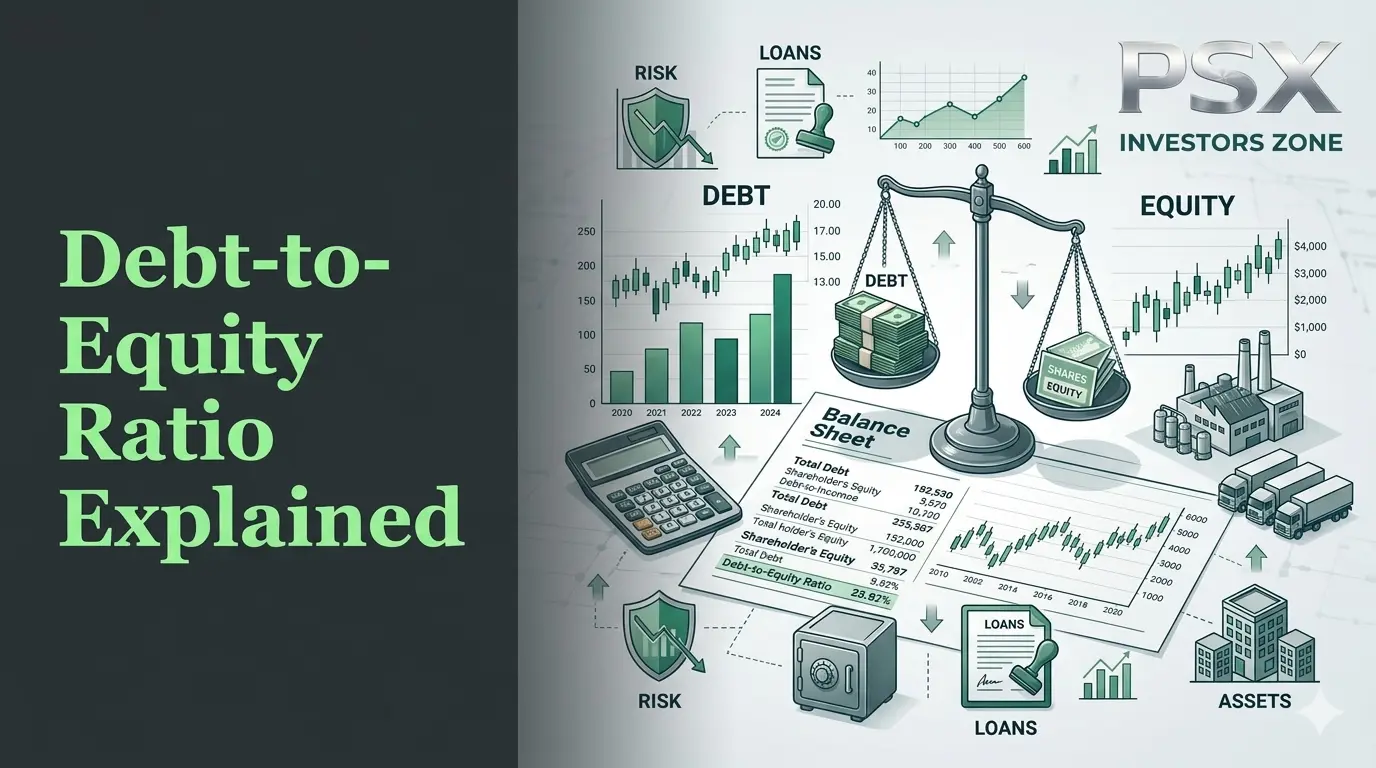
When investing in the Pakistan Stock Exchange (PSX), profitability is only one part of the story. A company may report impressive earnings, but if it has taken on excessive debt, its financial stability could be at risk.
One of the simplest and most effective ways to evaluate a company's financial leverage is by using the Debt-to-Equity (D/E) Ratio.
This important financial ratio helps investors understand how a company finances its operations and whether it relies more on borrowed money or shareholders' funds.
At PSX Investors Zone, we encourage investors to look beyond profits and examine a company's overall financial strength before making investment decisions.
What Is the Debt-to-Equity Ratio?
The Debt-to-Equity (D/E) Ratio compares a company's total debt with its shareholders' equity.
In simple terms:
The Debt-to-Equity Ratio shows how much debt a company uses for every rupee of shareholders' equity.
A lower ratio generally indicates lower financial risk, while a higher ratio suggests greater reliance on borrowed funds.
Debt-to-Equity Ratio Formula
Formula
Debt-to-Equity Ratio = Total Liabilities ÷ Shareholders' Equity
Example
Suppose a company has:
- Total Liabilities = Rs. 8 Billion
- Shareholders' Equity = Rs. 16 Billion
Calculation:
Debt-to-Equity Ratio = 8 ÷ 16 = 0.50
This means the company has Rs. 0.50 of debt for every Rs. 1.00 of shareholders' equity.
Why Is the Debt-to-Equity Ratio Important?
The D/E Ratio helps investors:
- Evaluate financial risk.
- Understand how the business is financed.
- Compare companies within the same industry.
- Assess long-term financial stability.
- Identify companies that may struggle during economic downturns.
It is one of the key ratios used in fundamental analysis.
What Does a Low Debt-to-Equity Ratio Mean?
A lower D/E Ratio generally indicates:
- Lower financial risk.
- Reduced interest payment obligations.
- Greater financial flexibility.
- Stronger balance sheet.
- Better ability to withstand challenging market conditions.
However, an extremely low ratio may also suggest that a company is not fully utilizing debt to support growth. Interpretation depends on the company's strategy and industry.
What Does a High Debt-to-Equity Ratio Mean?
A higher D/E Ratio may indicate:
- Greater reliance on borrowed funds.
- Higher interest expenses.
- Increased financial risk.
- Greater sensitivity to rising interest rates.
- Potential pressure on future cash flows.
A high ratio is not automatically negative. Some businesses and industries naturally operate with higher debt levels due to the capital-intensive nature of their operations.
Which Industries Usually Have Higher Debt?
Industries that often carry higher debt include:
- Cement
- Power Generation
- Oil & Gas
- Infrastructure
- Telecommunications
- Real Estate
These sectors typically require substantial investments in fixed assets and long-term projects.
Which Industries Usually Have Lower Debt?
Businesses that often maintain lower debt levels include:
- Technology
- Software
- Asset-light service companies
- Consulting firms
Always compare companies within the same industry rather than across different sectors.
Debt-to-Equity Ratio vs ROE
These two financial ratios provide different insights.
| Ratio | Measures |
|---|---|
| Debt-to-Equity Ratio | Financial leverage and risk |
| Return on Equity (ROE) | Profit generated from shareholders' equity |
A company may report a strong ROE while also carrying substantial debt. Reviewing both ratios together provides a more balanced understanding of financial performance and risk.
Practical Example
| Company | Total Debt | Shareholders' Equity | D/E Ratio |
|---|---|---|---|
| Company A | Rs. 5 Billion | Rs. 20 Billion | 0.25 |
| Company B | Rs. 15 Billion | Rs. 20 Billion | 0.75 |
Although both companies have the same amount of equity, Company B relies more heavily on borrowed funds.
This may increase financial risk, particularly if interest rates rise or business conditions weaken.
Limitations of the Debt-to-Equity Ratio
Like any financial metric, the D/E Ratio should not be used on its own.
It Doesn't Measure Profitability
A company may have low debt but weak profits.
Review profitability ratios such as ROE and ROA.
It Doesn't Measure Cash Flow
Debt may appear manageable on paper, but weak cash flow can make repayments difficult.
Always examine the Cash Flow Statement.
Industry Differences Matter
Some industries naturally maintain higher debt than others.
Avoid comparing companies from unrelated sectors.
Accounting Policies Can Affect Results
Balance sheet values may vary depending on accounting standards and asset valuations.
Financial Ratios to Use Alongside the D/E Ratio
For a more complete analysis, review:
- Return on Equity (ROE)
- Return on Assets (ROA)
- Earnings Per Share (EPS)
- Price-to-Earnings (P/E) Ratio
- Price-to-Book (P/B) Ratio
- Current Ratio
- Interest Coverage Ratio
- Operating Cash Flow
- Net Profit Margin
Using multiple financial ratios helps investors develop a more comprehensive understanding of a company's financial health.
Common Mistakes Investors Make
Assuming Low Debt Always Means a Better Company
A company with very little debt may still struggle with poor profitability or slow growth.
Ignoring Interest Rate Risk
Companies with significant debt may face higher financing costs when interest rates increase.
Comparing Different Industries
Debt levels should always be evaluated relative to industry norms.
Relying on One Financial Ratio
Investment decisions should never be based on a single metric.
How PSX Investors Zone Helps Investors
At PSX Investors Zone, we provide practical educational resources on:
- Financial Ratios
- Company Analysis
- Fundamental Analysis
- Financial Statements
- Annual Reports
- Dividend Investing
- Risk Management
- Long-Term Investing
- Shariah-Compliant Investing
Our mission is to help investors build knowledge and confidence through research-based financial education.
Key Takeaways
- The Debt-to-Equity Ratio measures a company's financial leverage.
- A lower ratio generally indicates lower financial risk.
- High debt is not always negative but should be assessed carefully.
- Compare companies within the same industry.
- Combine the D/E Ratio with ROE, ROA, cash flow, and other financial metrics before investing.
Frequently Asked Questions
What is a good Debt-to-Equity Ratio?
There is no universal benchmark. A suitable D/E Ratio depends on the company's industry, business model, and capital requirements.
Is a lower Debt-to-Equity Ratio always better?
Not necessarily. While lower debt often reduces financial risk, some companies use debt effectively to support business growth.
Can a company have no debt?
Yes. Some businesses operate with little or no debt, relying primarily on shareholders' equity and internally generated cash.
Why is the Debt-to-Equity Ratio important?
It helps investors assess financial risk, understand how a company is financed, and evaluate its long-term financial stability.
Should I rely only on the D/E Ratio?
No. Investors should consider the D/E Ratio alongside profitability, cash flow, and valuation metrics for a more complete analysis.
Conclusion
The Debt-to-Equity Ratio is one of the most important financial ratios for evaluating a company's financial structure and risk.
While a lower ratio often indicates a stronger balance sheet, the ideal level depends on the company's industry and business model. Rather than focusing on one metric, investors should combine the D/E Ratio with profitability, cash flow, and valuation analysis to make well-informed investment decisions.
By understanding how debt influences financial performance, you can better assess the long-term strength and resilience of companies listed on the Pakistan Stock Exchange.
Educational Disclaimer: This article is for educational purposes only and does not constitute financial, investment, legal, tax, or Shariah advice. Investing in the Pakistan Stock Exchange involves risk, including the possible loss of capital. Always conduct your own research and consult qualified professionals before making investment decisions.