How SBP Interest Rates Affect the Pakistan Stock Exchange
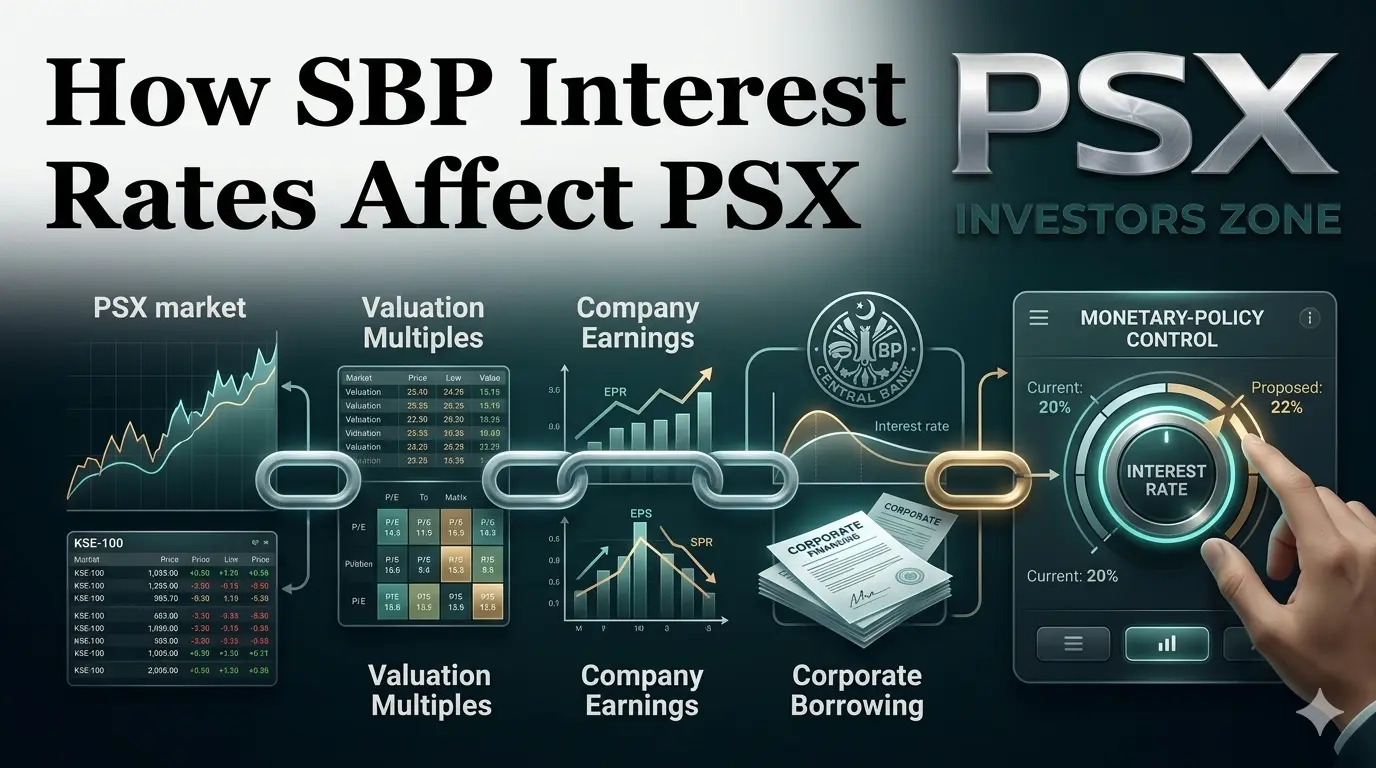
Interest rates are one of the most important economic factors influencing the Pakistan Stock Exchange (PSX).
When the State Bank of Pakistan (SBP) changes its policy rate, the effects can spread through borrowing costs, business profits, consumer spending, investment activity, stock valuations, and investor sentiment.
For PSX investors, understanding this relationship can help explain why the stock market can react strongly to monetary policy decisions.
However, the impact is not the same for every company or sector.
At PSX Investors Zone, our focus is on practical investor education, fundamental analysis, and Shariah-compliant investing principles.
What Is the SBP Policy Rate?
The SBP Policy Rate is a key interest rate used by the State Bank of Pakistan as part of its monetary policy.
It influences broader financial conditions in Pakistan and can affect the cost of borrowing across the economy.
When the policy rate changes, it can influence:
- Business borrowing costs
- Consumer financing
- Bank lending
- Investment activity
- Economic growth
- Corporate profitability
- Stock valuations
This is why PSX investors should pay attention to major SBP monetary policy decisions.
How Do Interest Rates Affect PSX?
The relationship can be simplified as:
SBP Policy Rate → Borrowing Costs → Company Earnings → Valuations → Stock Prices
When interest rates decline, borrowing can become cheaper.
Companies with debt may potentially experience lower finance costs, while businesses dependent on financing may see stronger demand.
When interest rates increase, borrowing becomes more expensive and can put pressure on companies with significant debt.
However, the actual impact depends on the company's business model, financial position, sector, and the reason behind the rate change.
What Happens When SBP Cuts Interest Rates?
An interest rate cut can affect PSX through several channels.
1. Borrowing Costs Can Decline
Companies that rely on debt financing may benefit from lower financing costs.
For example, if a company has substantial interest-bearing debt, a reduction in borrowing costs could potentially reduce its finance expenses.
This may improve:
- Net profit
- Earnings Per Share
- Cash flow
- Interest coverage
The actual benefit depends on the company's debt structure and how quickly its financing costs adjust.
2. Business Investment May Increase
Lower interest rates can make borrowing more attractive.
Companies may become more willing to invest in:
- New factories
- Machinery
- Expansion
- Working capital
- Infrastructure
- New projects
If economic activity increases, some businesses may experience stronger demand and revenue.
3. Consumer Spending Can Improve
Lower financing costs can support consumer borrowing and spending.
This can potentially benefit businesses connected to:
- Automobiles
- Consumer goods
- Housing
- Construction
- Retail
- Durable goods
However, consumer demand also depends on inflation, income, employment, confidence, and economic conditions.
4. Stock Valuations Can Receive Support
Interest rates can influence how investors value future earnings and cash flows.
When required returns decline, the present value of future cash flows can increase.
This can provide valuation support for equities.
However, lower rates do not automatically mean every stock becomes more attractive.
What Happens When SBP Raises Interest Rates?
Rate increases can create pressure through several channels.
Higher Financing Costs
Companies with floating-rate or frequently refinanced debt may face higher interest expenses.
Higher finance costs can reduce earnings if operating profits do not increase enough to compensate.
Lower Investment Activity
Higher borrowing costs can discourage businesses from taking on new debt for expansion.
Companies may delay:
- Expansion projects
- New factories
- Capital expenditure
- Business acquisitions
Pressure on Consumer Demand
Higher financing costs can make certain purchases more expensive.
This may affect sectors that depend heavily on consumer financing.
Valuation Pressure
Higher interest rates can increase investors' required returns.
As the discount rate increases, the present value of future cash flows can decline.
This can put pressure on equity valuations, particularly for companies whose valuations depend heavily on future growth expectations.
Which PSX Sectors Can Be Sensitive to Interest Rates?
Different sectors can respond differently to changes in monetary policy.
Banks
Banks can be particularly sensitive to interest-rate conditions because their business involves lending and deposits.
However, the relationship is not simply:
Higher rates = better banks
Investors should examine:
- Net interest margin
- Deposit costs
- Loan growth
- Credit quality
- Provisioning
- Monetary-policy expectations
The effect can vary depending on the rate environment and banking structure.
Cement and Construction
Lower borrowing costs can support construction activity and investment.
Cement and construction-related companies may benefit if lower rates contribute to stronger economic activity.
However, investors should also consider:
- Energy costs
- Coal prices
- Demand
- Government development spending
- Competition
- Capacity utilization
Automobile Sector
Vehicle financing can be affected by borrowing costs.
Lower rates may improve affordability for financed purchases and potentially support automobile demand.
However, the sector is also influenced by:
- Exchange rates
- Import restrictions
- Raw-material costs
- Taxes
- Consumer income
- Auto financing conditions
Highly Leveraged Companies
Companies with significant interest-bearing debt can be more sensitive to interest-rate movements.
When rates decline, finance costs may fall.
When rates rise, interest expenses may increase.
This is why investors should examine the Debt-to-Equity Ratio and Interest Coverage Ratio.
Dividend Stocks
Interest rates can influence how investors compare dividend-paying stocks with other income-generating investments.
When market rates are high, some investors may find fixed-income alternatives more attractive.
When rates decline, dividend-paying equities can become relatively more attractive to some investors.
However, investors should focus on dividend sustainability, not simply dividend yield.
Why Interest Rates Affect Stock Valuation
One of the most important concepts is the relationship between interest rates and valuation.
Suppose an investor expects a company to generate cash flows for many years.
Those future cash flows need to be converted into today's value.
When the discount rate increases:
Present Value of Future Cash Flows ↓
When the discount rate decreases:
Present Value of Future Cash Flows ↑
This is one reason changes in interest-rate expectations can affect stock prices even before a company's actual earnings change.
Interest Rates and the P/E Ratio
The Price-to-Earnings (P/E) Ratio compares a company's market price with its earnings.
Interest rates can influence how much investors are willing to pay for those earnings.
When interest rates are high, investors may demand a higher expected return from equities.
This can put pressure on valuation multiples.
When rates decline, valuation multiples may receive support.
However, P/E ratios are also affected by:
- Earnings growth
- Business risk
- Inflation
- Economic conditions
- Industry outlook
- Investor sentiment
Therefore, interest rates should not be analyzed in isolation.
Interest Rates and the KSE-100 Index
The KSE-100 Index includes major companies from different sectors of the Pakistan Stock Exchange.
Because these companies have different business models, an interest-rate change can affect them differently.
For example:
- Banks may respond through lending and interest margins.
- Highly leveraged companies may respond through financing costs.
- Consumer businesses may respond through demand.
- Construction-related companies may respond through financing and economic activity.
- Export-oriented businesses may be affected indirectly through currency and economic conditions.
Therefore, investors should avoid assuming that every KSE-100 company will react in the same way.
Why the Market May Move Before the SBP Announcement
Stock markets are forward-looking.
Investors often adjust their expectations before an official monetary policy decision.
If the market expects an interest rate cut, some stocks may begin reacting before SBP announces the decision.
Similarly, if investors expect rates to remain high, valuations may adjust beforehand.
This means the market can react not only to:
What SBP does
but also to:
What investors expected SBP to do.
Rate Cuts Do Not Automatically Mean PSX Will Rise
This is one of the most important points for investors.
A rate cut can be supportive for equities, but PSX can still decline after a rate cut.
Why?
Because stock prices are influenced by many factors, including:
- Corporate earnings
- Inflation
- Exchange rates
- Political developments
- Economic growth
- Foreign investment
- Commodity prices
- Fiscal policy
- Global markets
- Investor sentiment
Therefore:
Rate Cut ≠ Guaranteed PSX Increase
Investors should always examine the broader economic and company-specific picture.
Example: How a Rate Cut Can Affect a Company
Suppose a company has:
- Operating Profit = Rs. 1 billion
- Interest Expense = Rs. 300 million
Its Interest Coverage Ratio is:
1,000 ÷ 300 = 3.33x
Now assume lower financing costs reduce its interest expense to Rs. 200 million.
If operating profit remains unchanged:
1,000 ÷ 200 = 5x
The company's interest coverage has improved.
This demonstrates how lower financing costs can potentially strengthen the financial position of a leveraged company.
However, actual company results depend on the structure of its debt and financing arrangements.
How PSX Investors Should Analyze an SBP Rate Decision
Instead of simply asking:
"Will PSX go up or down?"
Ask these questions.
1. Why Did SBP Change Rates?
Was the decision influenced by:
- Inflation
- Economic growth
- Currency stability
- External financing
- Monetary policy expectations?
2. Which Companies Are Most Exposed?
Look for companies with:
- High debt
- Large finance costs
- Floating-rate borrowing
- Interest-sensitive demand
3. What Happens to Earnings?
Consider whether financing costs, demand, and margins could change.
4. What Is Already Priced Into the Market?
If investors already expected a rate cut, the market may have already incorporated much of the news.
5. Are Valuations Attractive?
A favorable interest-rate environment does not automatically make an expensive stock a good investment.
Investors should still analyze valuation and fundamentals.
Financial Metrics to Review
When analyzing the effect of interest rates on a PSX company, consider:
- Debt-to-Equity Ratio
- Interest Coverage Ratio
- Free Cash Flow
- Operating Cash Flow
- Current Ratio
- Quick Ratio
- ROE
- ROA
- EPS
- P/E Ratio
- Dividend Payout Ratio
These metrics can help investors understand how monetary policy may affect a company's financial position.
Common Investor Mistakes
Mistake 1: Buying Because of a Rate Cut Alone
A rate cut is only one factor.
Always analyze the underlying company.
Mistake 2: Assuming All Sectors Benefit
Different businesses have different exposure to financing costs and economic activity.
Mistake 3: Ignoring Market Expectations
Markets react to the difference between expected and actual outcomes.
Mistake 4: Ignoring Valuation
A good company can still be an expensive investment.
Mistake 5: Ignoring Inflation
Interest-rate decisions are closely connected with inflation and broader economic conditions.
Financial Ratios to Combine With Interest-Rate Analysis
For stronger fundamental analysis, investors can combine monetary-policy analysis with:
Debt-to-Equity Ratio
Measures the relationship between debt and shareholders' equity.
Interest Coverage Ratio
Measures how comfortably operating earnings cover interest expenses.
Free Cash Flow
Shows how much cash remains after necessary capital expenditure.
P/E Ratio
Helps investors assess the relationship between market price and earnings.
Dividend Payout Ratio
Shows how much of a company's earnings are distributed as dividends.
Using several metrics provides a better picture than relying on one ratio.
How PSX Investors Zone Helps Investors
At PSX Investors Zone, we provide practical educational resources covering:
- Pakistan Stock Exchange
- Fundamental Analysis
- Financial Ratios
- Company Analysis
- Financial Statements
- Stock Valuation
- Economic Indicators
- Long-Term Investing
- Risk Management
- Dividend Analysis
- Shariah-Compliant Investing
Our goal is to help investors understand the fundamentals behind companies and markets rather than making decisions based only on short-term market movements.
Key Takeaways
- SBP interest rates can affect PSX through borrowing costs, earnings, valuations, and investor sentiment.
- Lower rates can reduce financing costs for some companies.
- Higher rates can increase financial pressure on leveraged businesses.
- Different PSX sectors can respond differently to monetary policy.
- Markets can react to expectations before an SBP announcement.
- A rate cut does not guarantee that PSX will rise.
- Investors should combine macroeconomic analysis with company fundamentals.
- Debt, cash flow, earnings, and valuation should be reviewed before making investment decisions.
Frequently Asked Questions
What is the SBP policy rate?
The SBP policy rate is a key monetary-policy interest rate used by the State Bank of Pakistan to influence financial conditions and economic activity.
How do SBP interest rates affect PSX?
SBP interest rates can affect borrowing costs, corporate earnings, consumer demand, stock valuations, and investor sentiment.
Are lower interest rates good for PSX?
Lower rates can support equities by reducing financing costs and potentially improving valuations, but the overall market response depends on economic conditions, expectations, and company fundamentals.
Which PSX stocks are most affected by interest rates?
Banks, highly leveraged companies, and businesses dependent on consumer or investment financing can be particularly sensitive to interest-rate changes.
Do higher interest rates always cause PSX to fall?
No. PSX is influenced by many factors, including corporate earnings, inflation, exchange rates, global markets, political developments, and investor expectations.
Why should PSX investors track SBP monetary policy?
SBP decisions can provide important information about borrowing costs, economic conditions, liquidity, and financial-market expectations.
Conclusion
SBP interest rates are an important part of the economic environment in which PSX-listed companies operate.
A change in the policy rate can influence borrowing costs, company earnings, consumer demand, investment activity, and stock valuations.
However, the impact is different for every company and sector.
For PSX investors, the best approach is not to treat an SBP rate decision as a simple buy or sell signal.
Instead, examine how the change could affect a company's debt, interest expense, cash flow, earnings, valuation, and future growth.
Understanding the relationship between monetary policy and the stock market can help investors make more informed and disciplined long-term investment decisions.
Educational Disclaimer: This article is for educational purposes only and does not constitute financial, investment, legal, tax, or Shariah advice. Investing in the Pakistan Stock Exchange involves risk, including the possible loss of capital. Always conduct your own research and consult qualified professionals before making investment decisions.