Long-Term Investing vs Trading: Which Strategy Is Better for PSX Investors?
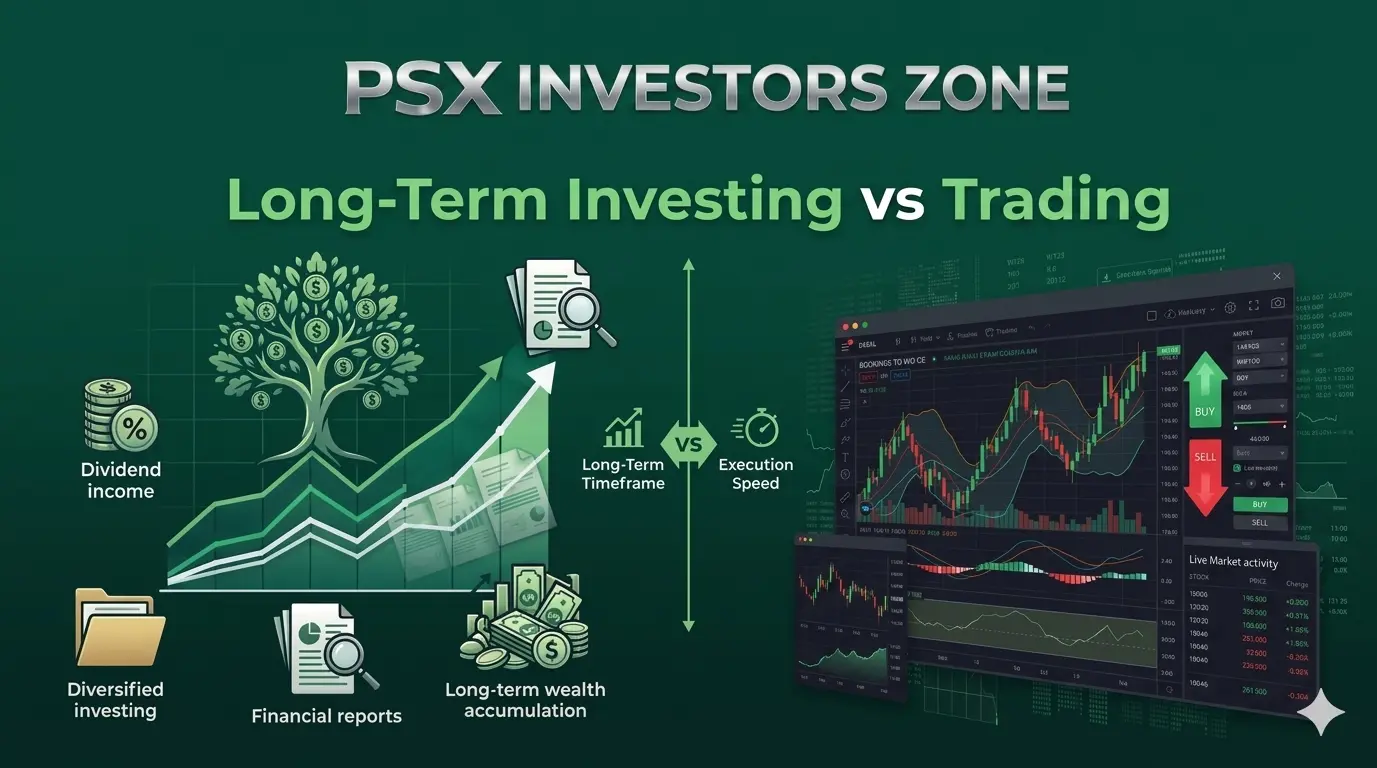
One of the first questions new investors ask is:
Should I invest for the long term or become a trader?
Both approaches involve buying and selling shares listed on the Pakistan Stock Exchange (PSX), but they differ significantly in terms of strategy, time horizon, risk, research, and decision-making.
There is no universal answer that suits everyone. The right approach depends on your financial goals, available time, knowledge, and tolerance for risk.
At PSX Investors Zone, we believe every investor should understand both approaches before deciding which one aligns with their objectives.
What Is Long-Term Investing?
Long-term investing involves purchasing shares of fundamentally strong companies and holding them for several years with the expectation that the business will grow over time.
Rather than focusing on daily price movements, long-term investors concentrate on:
- Business quality
- Financial performance
- Earnings growth
- Competitive advantages
- Long-term value creation
The goal is to participate in the company's growth rather than profit from short-term market fluctuations.
What Is Trading?
Trading focuses on taking advantage of short-term price movements.
Traders may hold positions for:
- Minutes
- Hours
- Days
- Weeks
Instead of emphasizing long-term business fundamentals, many traders rely on:
- Price charts
- Technical analysis
- Market momentum
- Trading volume
- News and market sentiment
Trading generally requires more active monitoring of the market.
Long-Term Investing vs Trading
| Feature | Long-Term Investing | Trading |
|---|---|---|
| Time Horizon | Years | Minutes to weeks |
| Primary Focus | Business growth | Price movements |
| Analysis | Fundamental analysis | Technical analysis (often combined with other methods) |
| Trading Frequency | Low | High |
| Time Commitment | Moderate | High |
| Transaction Costs | Lower due to fewer trades | Potentially higher due to frequent trading |
| Emotional Pressure | Generally lower | Often higher due to rapid market movements |
Advantages of Long-Term Investing
1. Focus on Business Fundamentals
Long-term investors evaluate companies based on financial health, profitability, management quality, and future growth prospects.
This encourages research-driven decision-making.
2. Less Frequent Trading
Buying and holding investments over longer periods usually involves fewer transactions.
This can reduce trading costs and discourage impulsive decision-making.
3. Reduced Impact of Daily Volatility
Short-term price fluctuations are common in every stock market.
Long-term investors often pay more attention to business performance than daily market noise.
4. Compounding Potential
When companies grow over time and distribute dividends, long-term investors may benefit from the effects of compounding if returns are reinvested.
Compounding depends on investment performance and is not guaranteed.
Challenges of Long-Term Investing
Long-term investing also requires:
- Patience
- Discipline
- Emotional control
- Confidence during market volatility
Investors must be prepared for periods when markets decline.
Advantages of Trading
1. More Frequent Opportunities
Active traders seek to benefit from short-term price movements that occur throughout the market.
2. Active Market Participation
Trading can appeal to individuals who enjoy analyzing charts, monitoring news, and following market activity closely.
3. Flexible Time Horizons
Different trading styles—such as intraday, swing, or position trading—offer varying holding periods and strategies.
Challenges of Trading
Trading is often more demanding than long-term investing.
It requires:
- Continuous market monitoring
- Strong risk management
- Emotional discipline
- Knowledge of technical analysis
- Well-defined trading strategies
Frequent trading may also increase transaction costs.
Which Skills Are More Important?
Long-Term Investors
Focus on:
- Fundamental analysis
- Financial statements
- Industry research
- Company management
- Economic trends
Traders
Often focus on:
- Technical analysis
- Chart patterns
- Price action
- Volume analysis
- Market psychology
- Risk management
Both approaches require education and continuous learning.
Which Strategy Is Better for Beginners?
For many beginners, learning about businesses and investing with a long-term perspective may be a more manageable starting point.
It allows investors to:
- Build knowledge gradually.
- Develop disciplined investment habits.
- Understand company fundamentals.
- Avoid making decisions based solely on short-term market movements.
However, the most suitable approach depends on each individual's goals, financial circumstances, and experience.
Can You Combine Investing and Trading?
Yes.
Some investors allocate part of their portfolio to long-term investments while using a separate portion for shorter-term trading strategies.
If you choose this approach, clearly separate your investment objectives and manage risk carefully.
Common Misconceptions
"Trading Is Easy Money"
Trading involves significant risk and requires knowledge, discipline, and consistent risk management.
There are no guaranteed profits.
"Long-Term Investing Means Ignoring Your Portfolio"
Long-term investors should still review company performance, financial results, and significant developments periodically.
"You Need to Trade Every Day"
Many successful investors rarely trade.
Activity alone does not guarantee better investment outcomes.
How PSX Investors Zone Helps Investors
Our educational resources help investors understand both investing and trading by covering topics such as:
- Pakistan Stock Exchange Basics
- Fundamental Analysis
- Technical Analysis
- Financial Statements
- Company Analysis
- Risk Management
- Shariah-Compliant Investing
- Portfolio Diversification
Our mission is to empower investors with knowledge so they can make informed decisions based on research rather than speculation.
Key Takeaways
- Long-term investing focuses on business growth and fundamentals.
- Trading focuses on short-term price movements.
- Both approaches involve risk and require education.
- Beginners often benefit from first understanding company fundamentals and risk management.
- Choose an approach that matches your financial goals, available time, knowledge, and risk tolerance.
Frequently Asked Questions
Is investing safer than trading?
Both involve investment risk. Trading generally requires more frequent decision-making and active market monitoring, while long-term investing emphasizes business fundamentals and a longer investment horizon.
Can beginners start with trading?
Beginners may benefit from first learning the basics of investing, company analysis, and risk management before engaging in active trading.
Do I need technical analysis for long-term investing?
Long-term investors often rely primarily on fundamental analysis, though some also use technical analysis to help identify entry and exit points.
Which strategy requires more time?
Trading typically requires more active monitoring and time commitment than long-term investing.
Can I be both an investor and a trader?
Yes. Some individuals maintain a long-term investment portfolio while separately allocating funds for trading, provided they have a clear strategy and appropriate risk management.
Conclusion
Long-term investing and trading are two different approaches to participating in the Pakistan Stock Exchange. Neither is inherently better than the other—the right choice depends on your goals, experience, available time, and ability to manage risk.
For many new investors, building a strong foundation in financial literacy, company analysis, and disciplined investing can be a valuable first step before exploring more active strategies.
The most successful market participants are often those who continue learning, follow a clear plan, and avoid emotional decision-making.
Educational Disclaimer: This article is for educational purposes only and should not be considered financial, investment, legal, tax, or Shariah advice. Investing and trading in the Pakistan Stock Exchange involve risk, including the potential loss of capital. Always conduct your own research and consult qualified professionals before making investment decisions.