PSX Capital Gains Tax 2026: Tax Rate on Stock Market Profit in Pakistan
Introduction
Making a profit from a PSX investment is exciting, but investors should also understand the tax implications of selling shares at a gain.
In Pakistan, Capital Gains Tax (CGT) can apply when investors dispose of listed securities traded through the Pakistan Stock Exchange.
For Tax Year 2026, the applicable CGT rate depends largely on when the securities were acquired, while older securities can fall under different historical rate structures.
For securities acquired on or after July 1, 2025, NCCPL currently lists a 15% CGT rate for both investors appearing on the Active Taxpayers' List (ATL) and those not appearing on ATL. Older securities can have different rates depending on their acquisition date and holding period. :contentReference[oaicite:0]{index=0}
This makes the acquisition date an important part of calculating the tax on PSX capital gains.
Important: Tax laws and rates can change. This article reflects the Tax Year 2026 framework based on currently available official NCCPL and FBR information and is intended for educational purposes, not tax advice.
What Is Capital Gains Tax?
Capital Gains Tax (CGT) is a tax imposed on a capital gain arising from the disposal of certain assets.
For PSX investors, the relevant gain generally arises when listed securities are sold for more than their applicable cost.
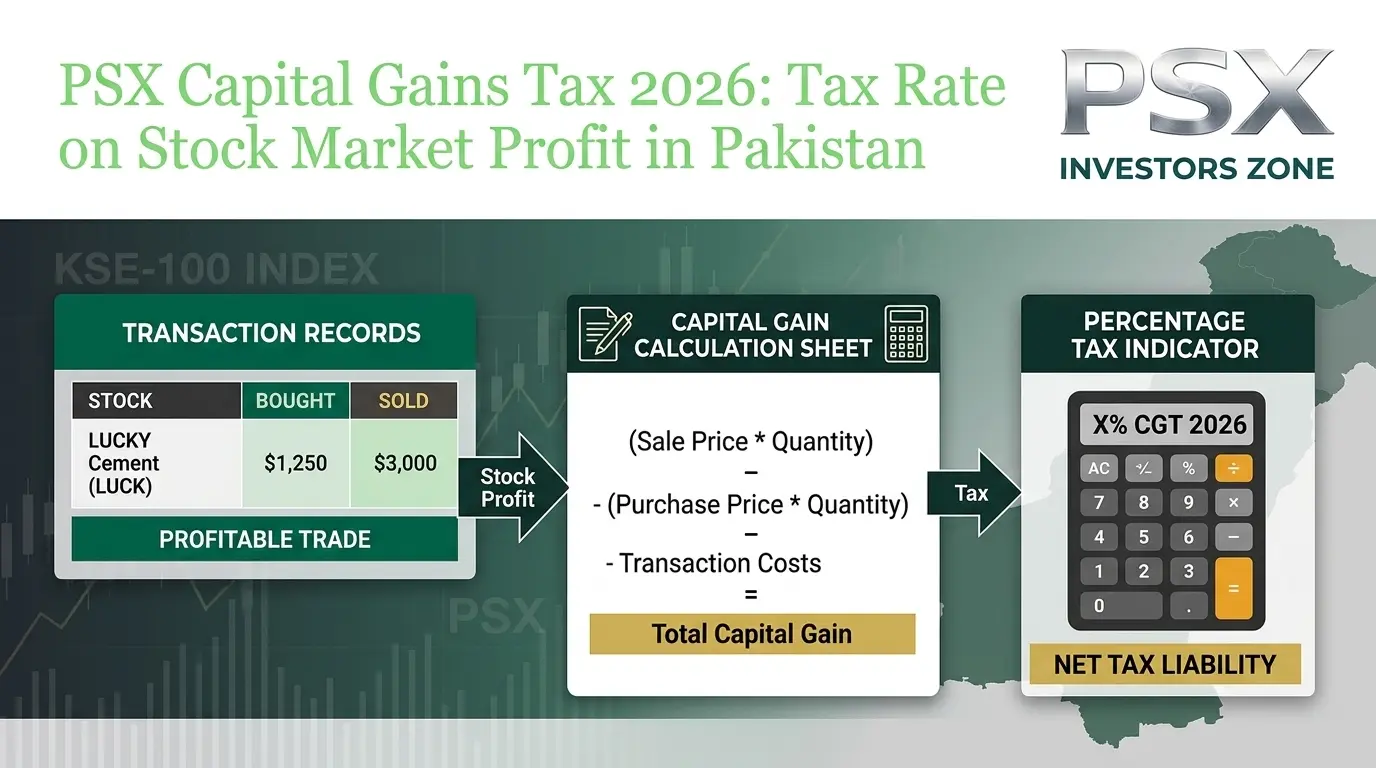
A simplified example:
Purchase value = Rs. 500,000
Sale value = Rs. 600,000
Capital gain = Rs. 100,000
If the applicable CGT rate is 15%:
CGT = Rs. 100,000 × 15%
CGT = Rs. 15,000
The actual NCCPL computation can include the prescribed treatment of transaction-related expenses and applicable rules, so this simple example should not be treated as a complete tax calculation.
What Is the PSX Capital Gains Tax Rate in 2026?
For securities acquired on or after July 1, 2025, NCCPL's Tax Year 2026 table shows:
| Securities Acquisition Date | ATL Investor | Non-ATL Investor |
|---|---|---|
| On or after July 1, 2025 | 15% | 15% |
Therefore, for many investors buying PSX securities during Tax Year 2026, the headline CGT rate is:
15% of the applicable capital gain. :contentReference[oaicite:1]{index=1}
However, 15% is not the only rate that can appear in the Tax Year 2026 CGT framework because securities acquired in earlier periods can remain subject to different rates.
Why the Purchase Date Matters
One of the most important things PSX investors should understand is that the CGT rate is not necessarily determined only by the date you sell a stock.
The acquisition date of the security can determine which CGT regime applies.
For example, NCCPL's Tax Year 2026 schedule distinguishes between securities acquired:
- Before July 1, 2013
- July 1, 2013 to June 30, 2022
- July 1, 2022 to June 30, 2024
- July 1, 2024 to June 30, 2025
- On or after July 1, 2025
Therefore, two investors selling securities in 2026 could potentially face different CGT treatment depending on when those securities were acquired. :contentReference[oaicite:2]{index=2}
Tax Year 2026 CGT Rates for Older PSX Holdings
NCCPL's current Tax Year 2026 schedule provides the following treatment for different acquisition periods. :contentReference[oaicite:3]{index=3}
Securities Acquired Before July 1, 2013
The listed CGT rate is:
0%
for both ATL and non-ATL investors.
Securities Acquired From July 1, 2013 to June 30, 2022
For these securities, NCCPL's Tax Year 2026 schedule lists:
ATL: 12.5%
Non-ATL: 25%
This demonstrates why an investor's tax status can still matter for certain older holdings. :contentReference[oaicite:4]{index=4}
Securities Acquired From July 1, 2022 to June 30, 2024
A regressive rate structure applies depending on the holding period.
| Holding Period | ATL | Non-ATL |
|---|---|---|
| More than 1 year to 2 years | 12.5% | 25% |
| More than 2 years to 3 years | 10% | 20% |
| More than 3 years to 4 years | 7.5% | 15% |
| More than 4 years to 5 years | 5% | 10% |
| More than 5 years to 6 years | 2.5% | 5% |
| More than 6 years | 0% | 0% |
These rates are part of the Tax Year 2026 schedule published by NCCPL. :contentReference[oaicite:5]{index=5}
Securities Acquired From July 1, 2024 to June 30, 2025
For securities acquired during this period, NCCPL's Tax Year 2026 table shows:
15% for ATL investors
30% for non-ATL investors
This is another example of why investors should not automatically assume that every PSX sale in 2026 is taxed at exactly the same rate. :contentReference[oaicite:6]{index=6}
Securities Acquired On or After July 1, 2025
For securities acquired on or after July 1, 2025, NCCPL lists:
15% for ATL investors
15% for non-ATL investors
This is the key rate relevant to many new PSX investments during Tax Year 2026. :contentReference[oaicite:7]{index=7}
Simple Example of 15% CGT
Suppose you purchase PSX shares for:
Rs. 1,000,000
You later sell them for:
Rs. 1,200,000
Your simplified capital gain is:
Rs. 200,000
If the applicable CGT rate is 15%:
Rs. 200,000 × 15% = Rs. 30,000
So the simplified amount of CGT would be:
Rs. 30,000
Your remaining gain after this simplified tax calculation would be:
Rs. 170,000
This example excludes other applicable taxes, charges and the detailed NCCPL calculation methodology.
What If You Sell a Stock at a Loss?
A capital loss is different from a capital gain.
Suppose:
Purchase value = Rs. 500,000
Sale value = Rs. 450,000
The simplified result is:
Capital loss = Rs. 50,000
NCCPL's CGT system takes gains and losses into account in determining the applicable tax position. NCCPL also states that excess CGT collected can be refunded through the broker where losses reduce the capital gain or result in a net loss situation during the tax year. :contentReference[oaicite:8]{index=8}
Investors should rely on their official NCCPL records and tax documentation for their individual position.
How Does NCCPL Handle CGT?
The National Clearing Company of Pakistan Limited (NCCPL) plays a central role in the CGT process for listed securities.
NCCPL is mandated by FBR to:
- Compute CGT
- Determine applicable capital gains
- Collect CGT
- Deposit CGT
- Provide annual capital-gain documentation
NCCPL also issues an Annual Certificate of Capital Gains to investors. :contentReference[oaicite:9]{index=9}
This makes NCCPL an important source of information for PSX investors when preparing their tax records.
Does Your Broker Calculate the Tax?
The PSX capital-market CGT framework is centrally administered through NCCPL.
NCCPL calculates and determines CGT based on the applicable rules and market transaction data.
Investors should therefore maintain their:
- Broker statements
- NCCPL records
- Annual CGT certificate
- Purchase records
- Sale records
- Tax-return documentation
NCCPL states that its annual certificate provides details of the capital gain and tax and is used for tax-return purposes. :contentReference[oaicite:10]{index=10}
What Is the Active Taxpayers' List (ATL)?
The Active Taxpayers' List (ATL) is maintained by the Federal Board of Revenue.
For certain categories of PSX securities acquired in earlier periods, NCCPL's Tax Year 2026 schedule shows different CGT rates for investors appearing on ATL versus those not appearing on ATL.
However, for securities acquired on or after July 1, 2025, NCCPL's current Tax Year 2026 table shows the same 15% rate for both categories. :contentReference[oaicite:11]{index=11}
This is why investors should check the rate applicable to the specific securities and acquisition period rather than relying on a generic filer/non-filer assumption.
Does Holding a Stock for Longer Reduce CGT?
It depends on the acquisition period.
The Tax Year 2026 framework contains different rules for securities acquired during different historical periods.
For example, securities acquired between July 1, 2022 and June 30, 2024 have regressive rates based on holding period, including a 0% rate where the holding period exceeds six years. :contentReference[oaicite:12]{index=12}
However, securities acquired on or after July 1, 2025 are listed at a 15% rate rather than a progressively declining rate based on holding period.
Therefore:
Long-term holding does not automatically mean zero CGT for every PSX investment.
Does CGT Apply to Dividends?
Capital Gains Tax and dividend taxation are separate concepts.
CGT relates to capital gains arising from the disposal of securities.
Dividend tax relates to income received as dividends.
Therefore, investors should not assume that the tax treatment of a stock sale is the same as the tax treatment of dividend income.
For a complete tax position, both should be considered separately.
CGT vs Brokerage Charges
CGT is not the same thing as brokerage commission.
When buying or selling PSX shares, investors may encounter various costs and taxes, including:
- CGT
- Brokerage commission
- Transaction-related charges
- CVT and other applicable charges
PSX notes that several taxes and charges can apply to share trading. :contentReference[oaicite:13]{index=13}
NCCPL also explains that its CGT calculation mechanism provides prescribed adjustments for certain acquisition and disposal expenses rather than simply using every actual expense reported by the investor. :contentReference[oaicite:14]{index=14}
How CGT Affects Your Investment Return
Suppose your stock investment produces a:
20% gross capital gain
If the applicable CGT rate is 15%, the tax can reduce the amount of profit you ultimately retain.
This is why investors should think in terms of:
Gross Return
versus
Net Return After Taxes and Costs
For long-term investing, even relatively small differences in costs and taxes can become meaningful over time.
Example: Gross vs Net Profit
Suppose you invest:
Rs. 1,000,000
and sell your investment for:
Rs. 1,300,000
Gross capital gain:
Rs. 300,000
At a simplified 15% CGT:
Rs. 300,000 × 15% = Rs. 45,000
Remaining gain after simplified CGT:
Rs. 255,000
This does not represent the complete tax calculation because actual NCCPL computation can involve the prescribed methodology and applicable rules.
What About Very Large Capital Gains?
Very high-income taxpayers may also need to consider Super Tax under the applicable tax framework.
NCCPL's Tax Year 2026 information lists super-tax rates that increase at specified income thresholds, with the published table reaching 10% where the relevant income exceeds Rs. 500 million. :contentReference[oaicite:15]{index=15}
This is particularly relevant to high-income taxpayers and should not be confused with the standard 15% CGT rate applicable to securities acquired on or after July 1, 2025.
Investors with substantial gains should obtain professional tax advice.
How to Check Your PSX CGT
Investors should keep track of their official tax documentation.
A practical process is:
Step 1: Check Your Purchase Records
Identify when each security was acquired.
Step 2: Check Your Sale Records
Record the date and value of disposal.
Step 3: Review Your NCCPL Information
Check the CGT information associated with your transactions.
Step 4: Obtain Your Annual CGT Certificate
NCCPL issues an Annual Certificate of Capital Gains. :contentReference[oaicite:16]{index=16}
Step 5: Use the Information for Your Tax Return
Provide the applicable information when completing your tax return.
For complex cases, consult a qualified tax professional.
Common CGT Mistakes PSX Investors Make
Mistake 1: Assuming Every Stock Sale Is Taxed at 15%
The acquisition date matters.
Older securities can have different rates. :contentReference[oaicite:17]{index=17}
Mistake 2: Ignoring the Acquisition Date
The purchase date can determine the applicable CGT regime.
Mistake 3: Confusing Capital Gains With Dividends
They are separate categories of income and can have different tax treatment.
Mistake 4: Ignoring Losses
Capital losses can affect the overall CGT position under the applicable rules.
Mistake 5: Ignoring Transaction Costs
Your real investment return is affected by more than CGT.
Mistake 6: Relying on Old Tax Articles
Tax rates can change through annual Finance Acts and amendments.
Always verify current information.
Mistake 7: Treating Tax as an Afterthought
Taxes should be considered when evaluating expected investment returns.
How Investors Can Plan Around CGT
Tax planning does not mean avoiding tax.
It means understanding the applicable rules before making investment decisions.
Investors can:
- Keep accurate purchase records
- Understand the acquisition-date rules
- Monitor realized gains and losses
- Review NCCPL statements
- Maintain annual CGT certificates
- Consider taxes when calculating expected returns
- File accurate tax returns
- Seek professional advice for complex situations
The goal is to make informed investment decisions while complying with applicable tax laws.
Does CGT Make Long-Term Investing Less Attractive?
Not necessarily.
A tax should be considered as part of the overall investment equation.
A company that compounds earnings and dividends over many years can potentially generate substantial shareholder value even after applicable taxes and transaction costs.
The important question is not:
"Can I avoid CGT?"
A better question is:
"What is my expected net return after taxes, costs and risk?"
CGT and Shariah-Compliant Investing
For Shariah-conscious investors, tax compliance and Shariah compliance are separate considerations.
A stock can potentially meet Shariah screening criteria while still being subject to applicable Pakistani tax laws.
Similarly, paying CGT does not determine whether a company itself is Shariah-compliant.
Investors should separately evaluate:
- Business activity
- Financial ratios
- Interest-related income
- Shariah screening methodology
- Latest screening status
- Applicable tax obligations
PSX Investors Zone focuses on educational guidance for investors interested in Shariah-compliant investing, but investors should verify the latest applicable Shariah screening information before making decisions.
A Simple PSX CGT Checklist
Before selling a profitable PSX position, consider:
1. When did I acquire the shares?
2. What is my purchase cost?
3. What is my sale value?
4. What is my capital gain or loss?
5. Which CGT rate applies to this acquisition period?
6. Am I on the ATL?
7. What does my NCCPL record show?
8. Are there other applicable taxes or charges?
9. Have I considered the net return after tax?
10. Do I need professional tax advice?
Key Takeaways
- CGT can apply to capital gains arising from the disposal of PSX-listed securities.
- For securities acquired on or after July 1, 2025, NCCPL's Tax Year 2026 schedule lists a 15% CGT rate for both ATL and non-ATL investors. :contentReference[oaicite:18]{index=18}
- Older securities can have different CGT rates.
- Securities acquired between July 1, 2022 and June 30, 2024 can have regressive rates based on holding period.
- Securities acquired before July 1, 2013 are listed at a 0% rate under the Tax Year 2026 CGT schedule. :contentReference[oaicite:19]{index=19}
- NCCPL plays a central role in computing, collecting and documenting CGT for listed securities.
- NCCPL issues an Annual Certificate of Capital Gains.
- Capital gains tax is different from dividend taxation.
- Brokerage and other transaction charges are separate from CGT.
- Very high-income taxpayers may also need to consider applicable Super Tax.
- Investors should consider net returns after taxes and costs rather than gross returns alone.
- Tax rules can change, so investors should verify the latest official information before filing returns or making tax-sensitive decisions.
Frequently Asked Questions
What is the PSX capital gains tax rate in 2026?
For securities acquired on or after July 1, 2025, NCCPL's Tax Year 2026 schedule lists 15% for both ATL and non-ATL investors. Older acquisitions may be subject to different rates. :contentReference[oaicite:20]{index=20}
Is CGT charged on the entire sale amount?
No. CGT relates to the applicable capital gain, not simply the gross amount received from selling shares. The detailed NCCPL calculation follows the applicable tax rules and prescribed methodology.
Does holding a PSX stock for a long time eliminate CGT?
Not automatically. The applicable treatment depends on the acquisition period and relevant tax rules. Certain securities acquired during specific historical periods can qualify for lower rates or 0% after specified holding periods. :contentReference[oaicite:21]{index=21}
Is CGT different for filers and non-filers?
It depends on when the securities were acquired. For securities acquired on or after July 1, 2025, the Tax Year 2026 rate listed by NCCPL is 15% for both ATL and non-ATL investors. :contentReference[oaicite:22]{index=22}
Who calculates CGT on PSX transactions?
NCCPL is mandated to compute, determine, collect and deposit CGT on listed securities under the applicable framework. :contentReference[oaicite:23]{index=23}
Does NCCPL provide a CGT certificate?
Yes. NCCPL issues an Annual Certificate of Capital Gains containing the relevant capital-gain and CGT information. :contentReference[oaicite:24]{index=24}
Is dividend tax the same as CGT?
No. Capital gains from selling securities and dividend income are separate tax categories and can have different tax treatment.
Can capital losses affect CGT?
Yes. NCCPL's system takes losses into account in determining the capital-gain tax position, and NCCPL states that excess CGT can be refunded through the broker in qualifying loss situations. :contentReference[oaicite:25]{index=25}
Can CGT rates change?
Yes. Pakistan's tax framework can be amended through legislation and related rules. Investors should verify the latest FBR and NCCPL information for the relevant tax year.
Conclusion
Understanding Capital Gains Tax is an important part of investing in the Pakistan Stock Exchange.
For many new PSX investments made during Tax Year 2026, the key figure is:
15% CGT on applicable capital gains for securities acquired on or after July 1, 2025. :contentReference[oaicite:26]{index=26}
But investors should not assume that every PSX investment follows this single rate.
The acquisition date, applicable tax rules and other circumstances can change the calculation.
A disciplined investor should therefore consider:
Investment Return + CGT + Transaction Costs + Risk
rather than looking at the stock's gross profit alone.
Keep your purchase and sale records, review your NCCPL CGT information and maintain your annual CGT certificate for tax reporting.
Most importantly, do not rely on outdated tax information. Tax rules can change, so verify the applicable rate with current official NCCPL/FBR information or a qualified tax professional before making tax-related decisions.
Educational Disclaimer: This article is for educational and informational purposes only and does not constitute tax, financial, investment, legal or Shariah advice. Tax laws, rates and interpretations may change. The examples are simplified and may not reflect an individual's complete tax position. Always verify the latest applicable rules with FBR/NCCPL or consult a qualified tax professional before filing your tax return or making investment decisions.