Pakistan Stock Market Tax Calculator 2026: Calculate Your Stock Investment Tax
Introduction
Making a profit from a Pakistan Stock Exchange investment is only one part of calculating your actual return.
Investors should also understand how Capital Gains Tax (CGT) can affect the profit they receive after selling shares.
For Tax Year 2026, the CGT treatment depends on factors including when the securities were acquired. For securities acquired on or after July 1, 2025, NCCPL lists a 15% CGT rate for both investors appearing on the Active Taxpayers' List (ATL) and those not appearing on ATL. Older securities can be subject to different rates. :contentReference[oaicite:0]{index=0}
This guide explains how to estimate PSX stock-market tax using a simple calculator framework.
Important: This calculator is an educational estimation tool, not a tax filing tool. Actual CGT is determined under the applicable law and NCCPL's prescribed calculation methodology. Always verify your actual tax position using official NCCPL/FBR information or a qualified tax professional.
What Is PSX Capital Gains Tax?
Capital Gains Tax is tax on the applicable gain arising from the disposal of securities.
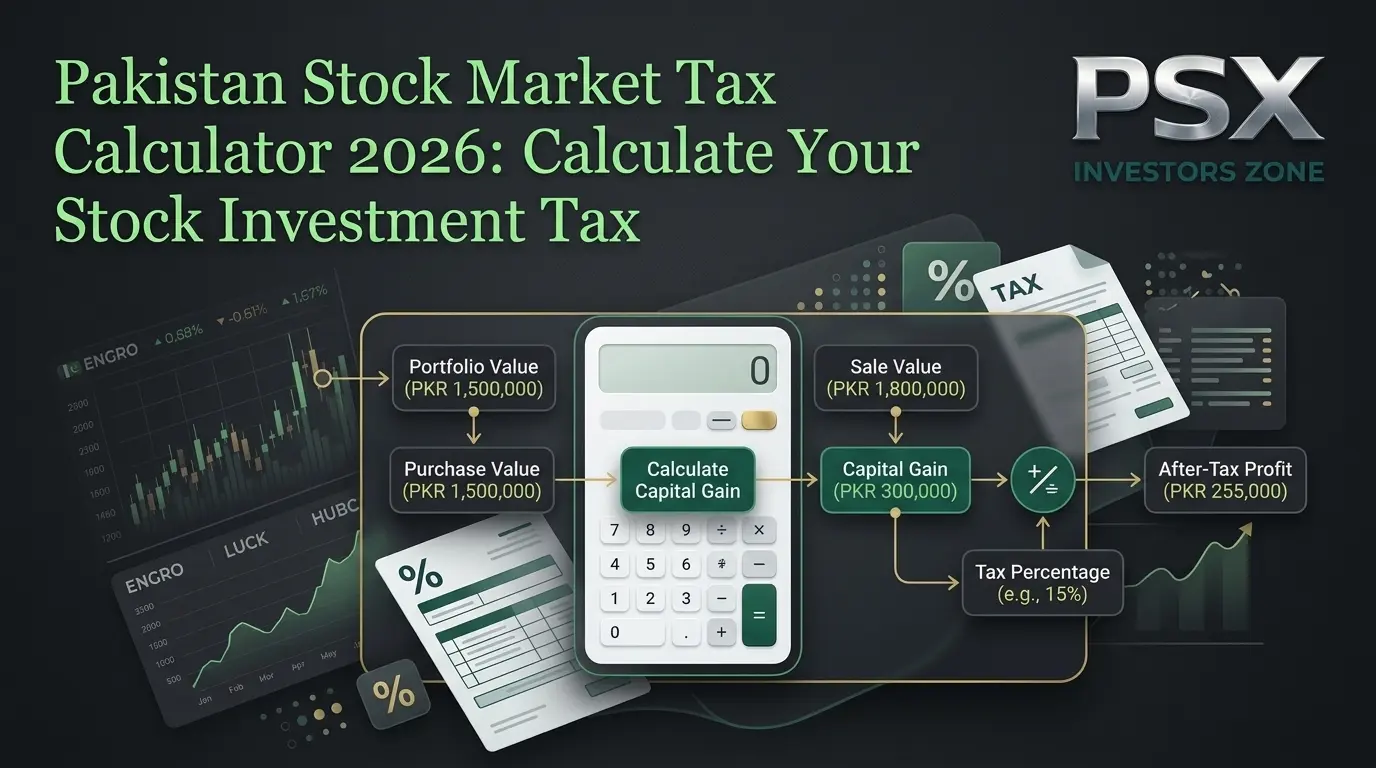
A simplified calculation is:
Capital Gain = Sale Value − Applicable Cost
Then:
Estimated CGT = Capital Gain × Applicable CGT Rate
For example:
Purchase value:
Rs. 500,000
Sale value:
Rs. 600,000
Simplified capital gain:
Rs. 100,000
If the applicable rate is 15%:
Estimated CGT = Rs. 100,000 × 15%
Estimated CGT = Rs. 15,000
This is only a simplified example and does not replace the actual NCCPL calculation.
Pakistan Stock Market Tax Calculator 2026
Use the following basic inputs to estimate your potential CGT:
Input 1: Purchase Value
Enter the amount you paid for the shares.
Example: Rs. 1,000,000
Input 2: Sale Value
Enter the amount you received when selling the shares.
Example: Rs. 1,250,000
Input 3: Applicable CGT Rate
Select the rate applicable to your securities based on the acquisition date and relevant tax rules.
For securities acquired on or after July 1, 2025, NCCPL's Tax Year 2026 table lists:
15%
for both ATL and non-ATL investors. :contentReference[oaicite:1]{index=1}
Estimated Calculation
Capital Gain = Rs. 1,250,000 − Rs. 1,000,000
Capital Gain = Rs. 250,000
Estimated CGT = Rs. 250,000 × 15%
Estimated CGT = Rs. 37,500
Estimated Profit After CGT
Rs. 250,000 − Rs. 37,500 = Rs. 212,500
Again, this is a simplified illustration.
Quick PSX Tax Calculator Formula
You can use this formula for a basic estimate:
Capital Gain = Sale Value − Purchase Value
Then:
Estimated Tax = Capital Gain × CGT Rate
And:
Estimated Profit After Tax = Capital Gain − Estimated Tax
For example:
| Calculation | Amount |
|---|---|
| Purchase Value | Rs. 1,000,000 |
| Sale Value | Rs. 1,250,000 |
| Capital Gain | Rs. 250,000 |
| Example CGT Rate | 15% |
| Estimated CGT | Rs. 37,500 |
| Estimated Profit After CGT | Rs. 212,500 |
What CGT Rate Should You Use in 2026?
This is one of the most important parts of the calculation.
NCCPL's Tax Year 2026 CGT schedule provides different treatments based on the acquisition period. :contentReference[oaicite:2]{index=2}
Securities Acquired Before July 1, 2013
ATL: 0%
Non-ATL: 0%
Securities Acquired From July 1, 2013 to June 30, 2022
NCCPL's current Tax Year 2026 table lists:
ATL: 12.5%
Non-ATL: 12.5% :contentReference[oaicite:3]{index=3}
Securities Acquired From July 1, 2022 to June 30, 2024
Regressive rates can apply according to the holding period.
| Holding Period | ATL | Non-ATL |
|---|---|---|
| More than 1 to 2 years | 12.5% | 25% |
| More than 2 to 3 years | 10% | 20% |
| More than 3 to 4 years | 7.5% | 15% |
| More than 4 to 5 years | 5% | 10% |
| More than 5 to 6 years | 2.5% | 5% |
| More than 6 years | 0% | 0% |
These are the rates listed by NCCPL for Tax Year 2026. :contentReference[oaicite:4]{index=4}
Securities Acquired From July 1, 2024 to June 30, 2025
ATL: 15%
Non-ATL: 15%
Securities Acquired On or After July 1, 2025
ATL: 15%
Non-ATL: 15% :contentReference[oaicite:5]{index=5}
Why the Acquisition Date Matters
A common mistake is assuming:
"I sold my PSX shares in 2026, so the tax rate must be 15%."
That is not necessarily correct.
The acquisition date can determine the applicable CGT regime.
For example:
Investor A
Bought shares in 2025.
Investor B
Bought shares several years earlier.
Both sell their shares during 2026.
Their CGT treatment may be different because the securities were acquired under different tax regimes.
Therefore, your calculator should always ask:
When did you acquire the shares?
Example: New PSX Investment
Suppose you purchase shares on:
August 1, 2025
Purchase value:
Rs. 800,000
You sell them in 2026 for:
Rs. 1,000,000
Simplified gain:
Rs. 200,000
Applicable CGT rate for securities acquired on or after July 1, 2025:
15%
Estimated CGT:
Rs. 30,000
Estimated gain after CGT:
Rs. 170,000
This does not include other applicable transaction costs or the detailed NCCPL methodology.
What If You Make a Loss?
A stock investment does not always produce a gain.
Suppose:
Purchase Value = Rs. 800,000
Sale Value = Rs. 700,000
Simplified result:
Capital Loss = Rs. 100,000
There is no positive capital gain on this transaction.
NCCPL's CGT system takes gains and losses into account in determining the applicable CGT position. NCCPL also provides information about refunds of excess CGT collected in qualifying situations. :contentReference[oaicite:6]{index=6}
Investors should use their official NCCPL records when determining their actual tax position.
Can Capital Losses Reduce Your Tax?
Capital losses can be relevant to the calculation of capital gains tax under the applicable rules.
For example, imagine:
Stock A Gain = Rs. 200,000
Stock B Loss = Rs. 80,000
A simplified net gain could be:
Rs. 200,000 − Rs. 80,000 = Rs. 120,000
If a 15% rate applied:
Rs. 120,000 × 15% = Rs. 18,000
However, actual NCCPL calculations can involve specific rules regarding the adjustment and treatment of losses.
Do not rely on a simple calculator for complex portfolios.
Does ATL Status Affect PSX CGT?
It can, depending on the acquisition period.
For securities acquired on or after July 1, 2025, NCCPL's Tax Year 2026 table lists the same 15% rate for ATL and non-ATL investors. :contentReference[oaicite:7]{index=7}
However, certain older acquisition periods have different ATL and non-ATL rates.
Therefore, the calculator should not simply ask:
"Are you a filer?"
It should first identify:
Acquisition Date + Applicable Tax Regime + ATL Status
How Much Tax Do You Pay on Rs. 100,000 Stock Profit?
If the applicable CGT rate is 15%:
Rs. 100,000 × 15% = Rs. 15,000
Estimated profit after CGT:
Rs. 85,000
This is a simple illustration for a situation where the 15% rate applies.
How Much Tax on Rs. 500,000 Stock Profit?
At a 15% rate:
Rs. 500,000 × 15% = Rs. 75,000
Estimated remaining gain:
Rs. 425,000
Again, this is an educational calculation and not necessarily the final tax liability.
How Much Tax on Rs. 1 Million Stock Profit?
At 15%:
Rs. 1,000,000 × 15% = Rs. 150,000
Estimated gain after CGT:
Rs. 850,000
The actual tax calculation can differ depending on the applicable rules and your complete tax position.
CGT Is Not Tax on the Entire Investment
This distinction is extremely important.
Suppose you:
Invest:
Rs. 1,000,000
Sell for:
Rs. 1,200,000
You do not simply calculate 15% of Rs. 1.2 million.
Your simplified capital gain is:
Rs. 200,000
The example CGT would therefore be calculated on the applicable gain, not the entire sale proceeds.
CGT vs Total Trading Costs
Your total cost of investing in PSX can include more than CGT.
Depending on the transaction, investors may encounter:
- Brokerage commission
- Applicable taxes
- Exchange-related charges
- NCCPL/CDC-related charges
- CGT
PSX provides information about taxes and charges associated with share transactions. :contentReference[oaicite:8]{index=8}
Therefore:
Gross Profit ≠ Net Profit
A better calculation is:
Net Return = Gross Gain − Taxes − Transaction Costs
How NCCPL Calculates PSX CGT
NCCPL plays a central role in the CGT process for listed securities.
The Income Tax Ordinance provides the legal framework for capital gains on securities, while NCCPL administers the applicable CGT process for listed-market transactions. :contentReference[oaicite:9]{index=9}
NCCPL also issues an Annual Certificate of Capital Gains, which provides investors with relevant capital-gain and tax information. :contentReference[oaicite:10]{index=10}
For tax filing, investors should rely on their official NCCPL certificate and records rather than a manually calculated website estimate.
What Is the NCCPL Annual CGT Certificate?
NCCPL issues an Annual Certificate of Capital Gains to taxpayers.
The certificate provides information about:
- Capital gains
- Capital losses
- CGT
- Relevant transactions
NCCPL states that the certificate is considered conclusive evidence of capital gain and tax thereon. :contentReference[oaicite:11]{index=11}
This makes the certificate an important document when preparing your tax records.
What About Super Tax?
High-income taxpayers may need to consider additional tax provisions.
NCCPL's Tax Year 2026 information lists Super Tax rates under section 4C for specified income levels. :contentReference[oaicite:12]{index=12}
Therefore, a basic:
Capital Gain × CGT Rate
calculator may not represent the complete tax liability for every taxpayer.
Investors with very large gains or complex tax situations should obtain professional advice.
Example: Comparing Gross and Net Returns
Suppose you invest:
Rs. 2,000,000
and later sell for:
Rs. 2,600,000
Gross capital gain:
Rs. 600,000
At an illustrative 15% CGT rate:
Rs. 600,000 × 15% = Rs. 90,000
Estimated gain after CGT:
Rs. 510,000
Gross return:
30%
The simplified after-CGT gain is:
25.5% of the original investment
before considering other transaction costs and any other tax implications.
This demonstrates why investors should calculate after-tax returns, not just headline gains.
Why Investors Should Calculate After-Tax Returns
Imagine two investments:
Investment A
Gross return: 20%
After-tax and after-cost return: 16%
Investment B
Gross return: 18%
After-tax and after-cost return: 17%
Investment A had the higher headline return.
But Investment B produced the higher net result.
Taxes and costs therefore matter when comparing investment opportunities.
How to Build a PSX Tax Calculator
A useful online calculator should include the following fields:
Purchase Price
Amount paid for the shares.
Sale Price
Amount received from selling the shares.
Acquisition Date
Determines which CGT regime may apply.
Sale Date
Identifies the disposal period.
ATL Status
Relevant for certain historical acquisition periods.
Capital Gain/Loss
Automatically calculated.
Applicable CGT Rate
Selected according to the relevant tax regime.
Estimated CGT
Automatically calculated.
Estimated Net Gain
Gain after estimated CGT.
The calculator should clearly state that the result is an estimate, not an official tax assessment.
Suggested Calculator Formula
For a basic educational calculator:
Step 1
Capital Gain:
Sale Value − Purchase Value
Step 2
Estimated CGT:
Capital Gain × Applicable Rate
Step 3
Estimated Gain After CGT:
Capital Gain − Estimated CGT
Step 4
Estimated Net Sale Proceeds:
Sale Value − Estimated CGT
For actual tax reporting, users should rely on NCCPL's official calculation and documentation.
Example Calculator Results
Example 1
Investment: Rs. 500,000
Sale: Rs. 600,000
Gain: Rs. 100,000
Illustrative CGT: 15%
Estimated CGT: Rs. 15,000
Estimated gain after CGT: Rs. 85,000
Example 2
Investment: Rs. 1,000,000
Sale: Rs. 1,500,000
Gain: Rs. 500,000
Illustrative CGT: 15%
Estimated CGT: Rs. 75,000
Estimated gain after CGT: Rs. 425,000
Example 3
Investment: Rs. 2,000,000
Sale: Rs. 3,000,000
Gain: Rs. 1,000,000
Illustrative CGT: 15%
Estimated CGT: Rs. 150,000
Estimated gain after CGT: Rs. 850,000
Important Limitations of a Stock Tax Calculator
An online calculator can provide a useful estimate.
But it cannot necessarily determine every individual's final tax liability.
The actual calculation can depend on:
- Acquisition date
- Disposal date
- Applicable tax regime
- ATL status
- Gains and losses
- Security type
- Prescribed calculation rules
- Other income
- Super Tax where applicable
- Changes in legislation
Therefore, use an online calculator for education and planning, not as a substitute for official tax records.
Common PSX Tax Calculation Mistakes
Mistake 1: Applying 15% to the Sale Value
CGT is not simply 15% of the entire amount received from selling shares.
Mistake 2: Ignoring Acquisition Date
Different acquisition periods can have different tax treatment.
Mistake 3: Ignoring Losses
Losses can affect the overall CGT calculation under applicable rules.
Mistake 4: Confusing CGT With Brokerage
They are separate costs.
Mistake 5: Using Outdated Rates
Tax rules can change.
Mistake 6: Treating an Online Calculator as an Official Tax Certificate
The official NCCPL records should take precedence.
Mistake 7: Ignoring Other Tax Provisions
High-income taxpayers may have additional considerations.
PSX Tax Calculator for Shariah-Conscious Investors
Tax and Shariah compliance are separate issues.
A Shariah-compliant stock can still be subject to applicable Pakistani tax laws.
Similarly, paying CGT does not determine whether an investment is Shariah-compliant.
Shariah-conscious investors should separately verify:
- Business activity
- Financial ratios
- Interest-related income
- Applicable screening methodology
- Latest Shariah status
Taxes should then be calculated separately according to Pakistani law.
How Investors Can Reduce Tax Surprises
Investors should not attempt to avoid tax illegally.
Instead, they should improve their record-keeping and planning.
Maintain:
- Purchase confirmations
- Sale confirmations
- Broker statements
- NCCPL records
- Annual CGT certificate
- Tax-return documents
Before selling a large position, understand the potential tax implications.
This can help you estimate the real net return from the investment.
Key Takeaways
- PSX investors may have to pay Capital Gains Tax when they realize taxable gains from selling listed securities.
- For securities acquired on or after July 1, 2025, NCCPL's Tax Year 2026 schedule lists a 15% CGT rate for ATL and non-ATL investors. :contentReference[oaicite:13]{index=13}
- Older securities can have different CGT rates.
- Acquisition date is a critical input for a PSX tax calculator.
- A simple calculation is Capital Gain × Applicable CGT Rate.
- CGT is not simply calculated on the entire sale value.
- Capital losses can affect the overall CGT position under applicable rules.
- Brokerage and other transaction costs are separate from CGT.
- NCCPL provides an Annual Certificate of Capital Gains. :contentReference[oaicite:14]{index=14}
- High-income taxpayers may have additional tax considerations.
- A calculator should be treated as an estimate rather than an official tax assessment.
- Investors should calculate after-tax returns, not just gross investment profits.
- Tax rules can change, so current NCCPL and FBR information should always be checked.
Frequently Asked Questions
How much tax do I pay on PSX profit in 2026?
It depends on the applicable CGT regime. For securities acquired on or after July 1, 2025, NCCPL lists a 15% CGT rate for Tax Year 2026. Older securities can have different rates. :contentReference[oaicite:15]{index=15}
How do I calculate tax on my PSX profit?
For a basic estimate:
Capital Gain = Sale Value − Applicable Cost
Then:
Estimated CGT = Capital Gain × Applicable CGT Rate
The actual NCCPL calculation should be used for tax reporting.
Is PSX CGT 15% in 2026?
For securities acquired on or after July 1, 2025, NCCPL's Tax Year 2026 schedule lists 15%. However, older acquisition periods can have different rates. :contentReference[oaicite:16]{index=16}
Is CGT charged on the total sale amount?
No. Capital gains tax applies to the applicable capital gain rather than simply the gross sale proceeds.
Does the purchase date matter?
Yes. The acquisition date can determine which CGT regime applies.
Does ATL status affect CGT?
It can for certain historical acquisition periods. For securities acquired on or after July 1, 2025, NCCPL currently lists the same 15% rate for ATL and non-ATL investors. :contentReference[oaicite:17]{index=17}
Can stock-market losses affect CGT?
Yes. Applicable gains and losses are considered under the CGT framework. NCCPL's system accounts for losses when determining the relevant tax position. :contentReference[oaicite:18]{index=18}
Who calculates PSX capital gains tax?
NCCPL plays the central role in computing and administering CGT for listed securities traded through the relevant market infrastructure. :contentReference[oaicite:19]{index=19}
Does NCCPL provide a tax certificate?
Yes. NCCPL issues an Annual Certificate of Capital Gains containing relevant capital-gain and tax information. :contentReference[oaicite:20]{index=20}
Is this calculator enough to file my tax return?
No. It is an educational estimation tool. Use your official NCCPL records and consult a qualified tax professional where necessary.
Conclusion
Understanding tax is an important part of calculating the real return from a PSX investment.
A stock may show a large profit on your broker screen, but your net investment return can be lower after applicable CGT and transaction costs.
For a basic estimate:
Capital Gain = Sale Value − Applicable Cost
Estimated CGT = Capital Gain × Applicable Rate
For Tax Year 2026, the headline rate for securities acquired on or after July 1, 2025 is 15%, according to NCCPL's published CGT schedule. :contentReference[oaicite:21]{index=21}
But do not apply 15% blindly to every PSX investment.
The acquisition date, holding period for certain older securities, ATL status and other applicable provisions can change the result.
The best approach is to use a calculator to understand your estimated tax, then verify the actual figure against your NCCPL records and Annual Certificate of Capital Gains.
Think beyond:
"How much did my stock make?"
Instead ask:
"How much did I actually keep after tax and costs?"
That is the number that matters when evaluating your true investment return.
Educational Disclaimer: This calculator and article are for educational and informational purposes only and do not constitute tax, financial, investment, legal or Shariah advice. Tax laws and rates can change. Calculator results are estimates and may not reflect the actual CGT determined by NCCPL or your complete tax liability. Always verify current rules and official records with NCCPL/FBR or consult a qualified tax professional.